
A Shang Dynasty Vessel Emerges: Poly Auction Hong Kong Presents an Ancient Bronze of Singular Refinement
AI-assisted voice playback. Starts only when you choose Play.
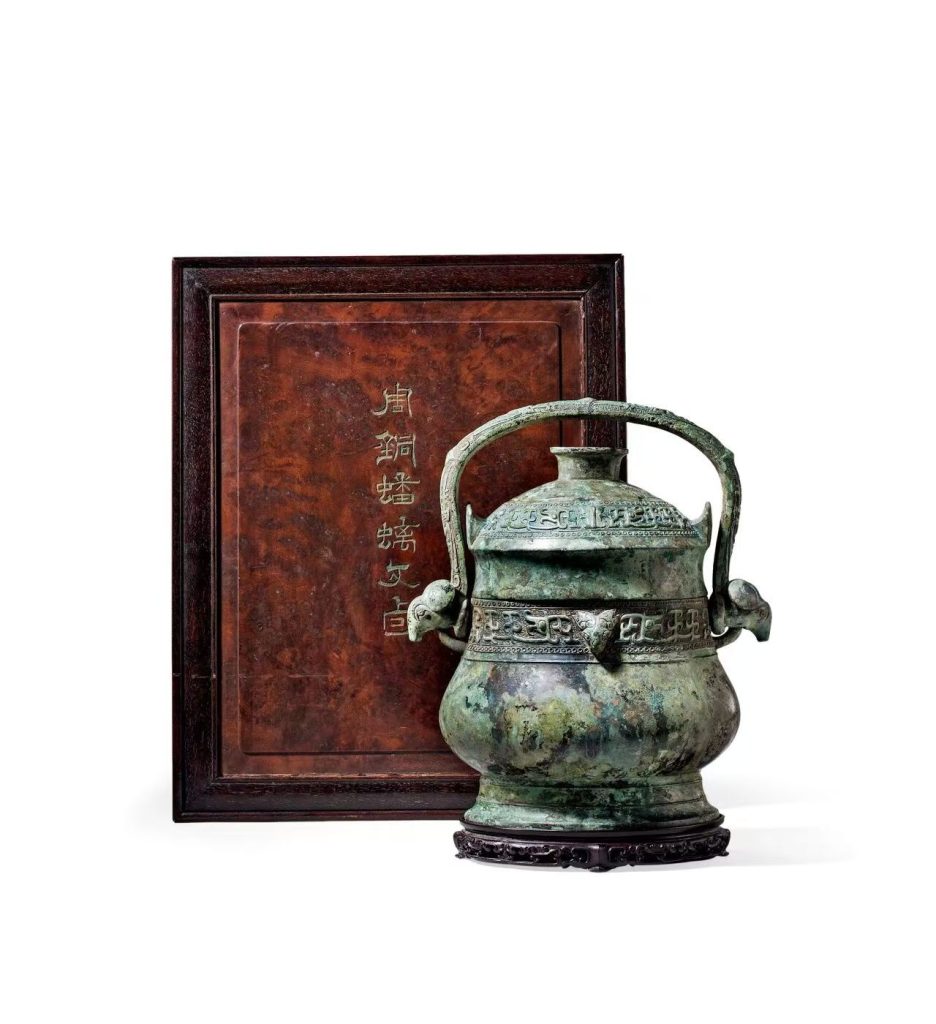
The passage of sacred objects across centuries and continents speaks to their enduring power. A bronze sacrificial vessel from the late Shang dynasty to early Western Zhou period, measuring 28 centimetres in height, carries within its form the weight of three thousand years of Asian cultural memory. It arrives at Poly Auction Hong Kong as part of the 千秋·物華 (Qianqiu: Material Splendour) sale, offered as Lot 5564, bearing the assured provenance of significant institutional and private holdings across Japan and East Asia.
Craftsmanship and Ceremonial Purpose
The vessel belongs to a category of bronze known as a kou, or sacrificial ewer, distinguished by its animal form and the finely cast qiulong (stylised dragon) motifs that encircle its surface. Such pieces served essential roles in ancestral rites and royal ceremonies, their decoration encoding layers of symbolic meaning understood by ancient courts. The rendering of the creature form at the vessel's neck displays the consummate skill of Shang bronzesmiths, whose command of the lost wax casting technique produced surfaces of remarkable precision and depth.
The Western Zhou period marked a continuation and evolution of these ceremonial traditions, even as the dynasty brought new political order to the Chinese lands. Bronze vessels from this transitional era represent a moment when ancient ritual forms persisted alongside emerging aesthetic refinements. The workmanship evident in this piece confirms its origin within the cultural sphere of the late Shang or earliest Western Zhou courts.
A Journey Through Collections and Scholarship
The documented history of this bronze extends back to before 1959, when it formed part of a private collection in Kyoto, Japan. From there it entered the holdings of the Yamanaka Trading Company, a venerable commercial establishment with deep connections to East Asian art and antiquities. Such repositories, though commercial in nature, often functioned as custodians of significant pieces during periods when systematic museum acquisition was less developed.
The vessel subsequently passed into the hands of Yui Sengoku in Tokyo, and was acquired by Poly Auction Hong Kong in October 2018. Its scholarly pedigree includes publication in Meigahara Suetoji's foundational 1959 work on Chinese bronzes in Japanese collections, and inclusion in the 2004 exhibition catalogue Essence of Chinese Dynasties, presented by the Osaka Art Club. Such documented scholarly attention affirms both the authenticity and significance of the piece within the broader discourse of ancient bronze study.
The Significance of Enduring Ritual
Works such as this bronze vessel remind collectors that the ancient world was not distant and abstract, but vividly material. These objects were held in hands, warmed by ritual fires, and treated as conduits between the living and the ancestral realm. The title of the sale itself, 千秋·物華, speaks to permanence and material refinement across ages—a concept deeply rooted in Chinese aesthetic philosophy.
For the international collector, the appearance of such a work at auction represents an opportunity to engage directly with a tangible expression of one of history's great civilisations. The bronze's journey from Shang courts to Japanese collections and now to a Hong Kong sale floor traces the routes by which cultural treasures have circulated in the modern era, each custodian adding a layer to its narrative.
Lot 5564 is offered in the 千秋·物華 sale at Poly Auction Hong Kong, with an estimate of HKD 2,700,000 to 3,500,000. The vessel invites those with the expertise and inclination to consider not merely a purchase, but the assumption of guardianship over an object that has survived dynasties and centuries.
Key Facts
- Object: Late Shang to early Western Zhou bronze sacrificial vessel (kou) with qiulong dragon motifs
- Height: 28 cm
- Lot Number: 5564, 千秋·物華 (Qianqiu: Material Splendour) sale
- Estimate: HKD 2,700,000 to 3,500,000
- Provenance: Kyoto private collection (before 1959), Yamanaka Trading Company, Yui Sengoku (Tokyo), Poly Auction Hong Kong (2018)
- Published: Meigahara Suetoji, Japanese Collections of Chinese Bronze Essentials (1959); Essence of Chinese Dynasties, Osaka Art Club (2004)
The Simply Luxury View
This bronze exemplifies why serious collectors continue to turn to auction houses with deep expertise in Asian material culture. Poly Auction Hong Kong has long specialised in ancient Chinese works, and the presence of such a piece in their sale reflects the calibre of scholarship and access that distinguishes major auction platforms.
The documented provenance through Japanese collections is particularly valuable, as such ownership histories often indicate pieces that were acquired during periods of connoisseurship rather than speculation. For the collector assembling a serious holding of ancient Asian bronze, authentication combined with scholarly publication and institutional exhibition history provides the foundation upon which confidence is built.
Official brand website: polyauction.com.hk
Imagery is used for editorial purposes. All rights remain with the respective owners, photographers and licensors.
Imagery courtesy of Poly Auction Hong Kong (@polyauctionhk).