
Himalayan Devotion: A Thirteenth Century Masterwork Returns to the Market
AI-assisted voice playback. Starts only when you choose Play.
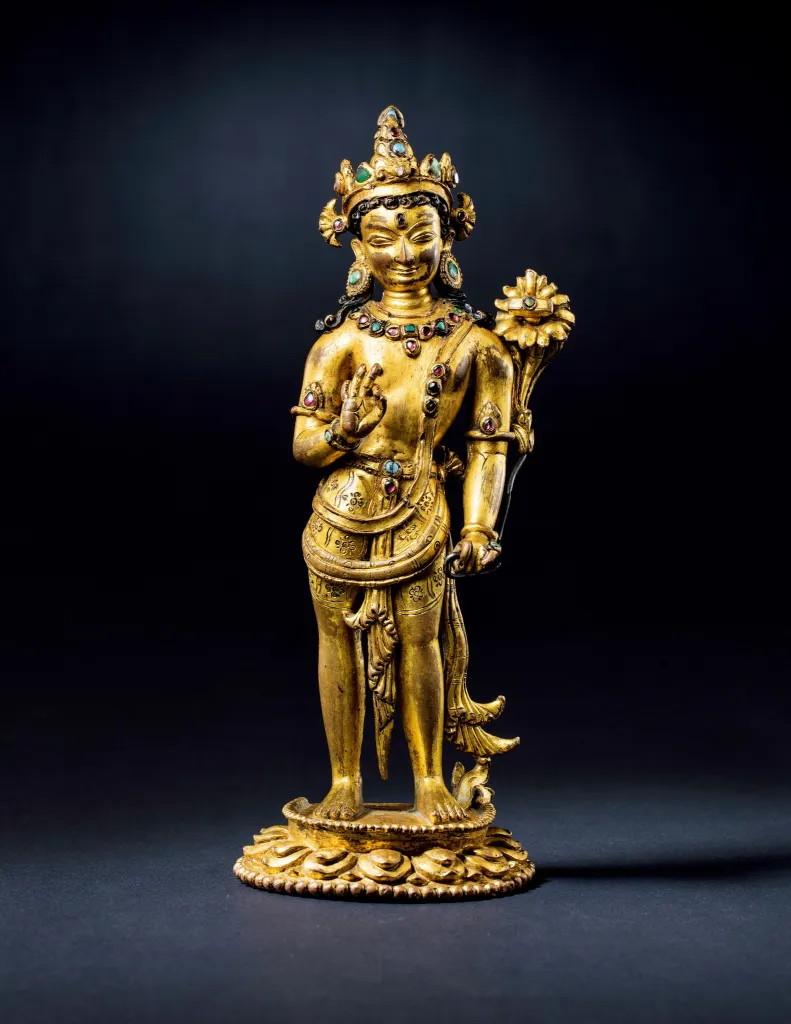
The Bodhisattva Manjushri, embodiment of transcendent wisdom, stands poised in bronze and gold, his crowned head tilted in eternal contemplation. This thirteenth century figure, wrought in the exquisite tradition of Kashmiri metalwork, speaks across seven centuries with the clarity of an undimmed flame. The sculptor, working in an age when Nepal commanded the spiritual and artistic heartbeat of the Himalayan world, captured in this seventeen and a half centimetre standing figure something far larger than its modest dimensions suggest: the distilled essence of enlightenment itself.
The Craft of Devotion
Medieval Nepal was a crucible of Buddhist artistic innovation, and Kashmir, though geographically distinct, shared a profound spiritual and aesthetic vocabulary with its neighbours. Gilt copper works of this calibre represent the apogee of a tradition that demanded not only technical mastery but also deep theological understanding. The marriage of precious metal and inlaid gemstones transforms a votive image into something approaching the sacred object itself. Each element—the burnished gold, the precise geometry of the figure's stance, the jewelled accents catching light—would have served both aesthetic and devotional purposes in the hands of its original worshipper.
Manjushri, the Bodhisattva of Wisdom, holds particular significance within Mahayana Buddhism. Iconographically complex, he is typically depicted with attributes that distinguish him from other celestial beings: a sword representing the cutting through of ignorance, and a lotus supporting a manuscript embodying supreme knowledge. In this standing figure, the sculptor has distilled these meanings into pure form, allowing the viewer's eye to rest upon the figure's serene expression and elegant proportions rather than upon elaborate symbolic apparatus.
A Collector's Season
The appearance of such a work at auction marks a moment of significance within the international market for Himalayan Buddhist art. Poly Auction Hong Kong's autumn season this year encompasses a thematic grouping titled 'Returning to the Original Heart: Flowers, Tea, and Treasures of Buddhist Art', positioning this Manjushri within a carefully curated context of spiritual and aesthetic inquiry. The catalogue placement as Lot 3005 reflects the house's confidence in the work's importance and provenance.
For collectors of Buddhist sculpture, particularly those drawn to the subtle sophistication of metalwork from this period and region, such opportunities are infrequent. The condition, scale and quality of execution evident in this figure place it among the works that define scholarly understanding of thirteenth century Nepalese production.
Viewing and Particulars
The work will be on view to the public during the preview period from 2 to 7 October 2026 at the Poly Auction Hong Kong galleries in Pacific Place, Hong Kong. This extended viewing window allows collectors and scholars to examine the object in person before the sale, an essential practice when assessing works of such antiquity and refinement.
In a world of contemporary noise and haste, this thirteenth century figure of Manjushri offers something increasingly rare: an object whose sole purpose was to anchor the mind toward wisdom, toward clarity, toward the transcendent. That it survives at all is fortune. That it remains radiant is grace.
Key Facts
- Artwork: Standing figure of Manjushri (Bodhisattva of Wisdom)
- Period: 13th century
- Origin: Nepal, Kashmiri tradition
- Medium: Gilt copper with inlaid gemstones
- Height: 17.5 cm
- Lot and Sale: Lot 3005, Poly Auction Hong Kong Autumn 2026
The Simply Luxury View
This Manjushri represents a category of work that has long commanded respect among serious collectors of Asian sculpture—not through fashion or market momentum, but through the inherent authority of its making and the clarity of its spiritual intention. Works of Kashmiri-influenced Nepalese metalwork from the thirteenth century are comparatively rare in the market, particularly examples of such refined execution and jewelled inlay.
For collectors already versed in Buddhist art, the appearance of such a figure signals the continuing availability of significant works within the Himalayan tradition. For those newly drawn to this field, it offers an entry point of undeniable quality: a work complete in itself, historically documented within a clear stylistic and geographical context, and possessed of the austere beauty that defines the finest examples of its period and region.
Official brand website: polyauction.com.hk
Imagery is used for editorial purposes. All rights remain with the respective owners, photographers and licensors.
Imagery courtesy of Poly Auction Hong Kong (@polyauctionhk).