
A Rare Window into Sarawak’s Colonial Past
AI-assisted voice playback. Starts only when you choose Play.
Few objects preserve the intricate layering of a particular moment in world history quite as economically as the banknote. In the case of this 1929 issue from Sarawak, a five dollar note bearing the portrait of Charles Vyner Brooke emerges not merely as currency but as a three-language statement: English, Chinese and Jawi script coexist across its face, each testifying to the diverse communities that inhabited Brooke's realm.
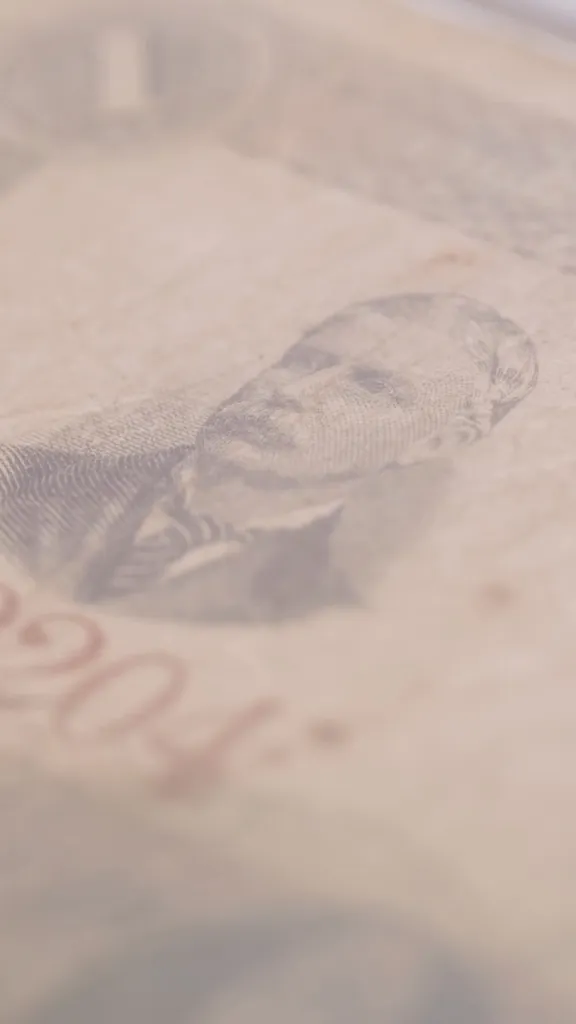
The White Rajah's Legacy
Charles Vyner Brooke ruled Sarawak as its third and final White Rajah, a figure of immense historical consequence whose authority extended across the territories of northern Borneo. Unlike conventional colonial administrations, the Brooke governance possessed a peculiar character, intertwining European entrepreneurship with deeply localised rule. The 1929 banknote stands as material evidence of this distinctive arrangement: the inclusion of Chinese and Jawi scripts on currency intended for circulation speaks to a monetary system designed not for homogeneous subjects but for merchants, officials and labourers operating across distinct cultural and linguistic boundaries.
That such notes survived in exemplary condition remains remarkable. Banknotes circulate, accumulate wear, tear and the gradations of exchange. This specimen, graded About Uncirculated 50 by the Paper Money Guarantee company, has endured nearly a century with minimal diminishment to its surfaces and printing clarity. For the collector of world currency, such preservation signals not merely rarity but the possibility that this particular note may have entered a private collection early in its existence, sheltered from the ordinary attrition of commerce.
Confluence and Contrast
The multilingual character of this banknote deserves particular attention from those concerned with the material culture of empire and trade. Sarawak, positioned along maritime routes of Southeast Asia, functioned as a place of genuine cultural synthesis. The appearance of three distinct written systems on a single economic instrument represents neither aesthetic novelty nor mere decoration, but rather a pragmatic acknowledgement of commercial reality. The note communicates across communities, suggesting an administration sufficiently responsive to its constituents' actual linguistic practices.
To hold such an object today is to hold an argument about how power was understood and exercised in early twentieth century Asia. It is a counter narrative to the monolithic colonial archive, offering instead evidence of negotiation, plurality and adaptation.
The Sale
Heritage Auctions will offer this lot during its October sale, with both live bidding and online participation available. For numismatists, historians and collectors drawn to the visual culture of empire and commerce, this represents an occasion to acquire an object that embodies both aesthetic refinement and historical weight. The particular moment of its issue, the political circumstances it reflects and its extraordinary state of preservation converge to create a lot of considerable consequence.
In an era when banknotes increasingly recede from daily circulation, displaced by digital payment systems, objects such as this acquire fresh significance. They become archives in miniature, paper records of states that no longer exist, languages once widespread, and systems of governance long transformed. This 1929 Sarawak note invites us to reconsider currency not as mere medium of exchange but as historical document, artistic production and cultural artefact.
Key Facts
- Date Issued: 1929
- Denomination: 5 Dollars
- Issuing Authority: Sarawak
- Portrait: Charles Vyner Brooke, the last White Rajah
- Grading: PMG About Uncirculated 50
- Languages Featured: English, Chinese and Jawi script
The Simply Luxury View
For the serious collector of world currency and colonial-era artefacts, this Sarawak banknote represents a convergence of rarity, condition and historical consequence. The trilingual inscription alone distinguishes it from most contemporary currency, offering tangible evidence of how power and commerce functioned across linguistic and cultural boundaries in early twentieth century Southeast Asia. The About Uncirculated 50 grade indicates both scarcity and the kind of preservation that rewards patient, knowledgeable collecting.
This lot speaks to those who understand that the most compelling historical documents are often those encountered in unexpected forms. A banknote need not be ancient to possess significance; it need only capture, with clarity and authenticity, a moment when multiple worlds intersected on a single surface.
Official brand website: heritageauctions.com
Imagery is used for editorial purposes. All rights remain with the respective owners, photographers and licensors.
Imagery courtesy of America's auction house (@heritageauctions).