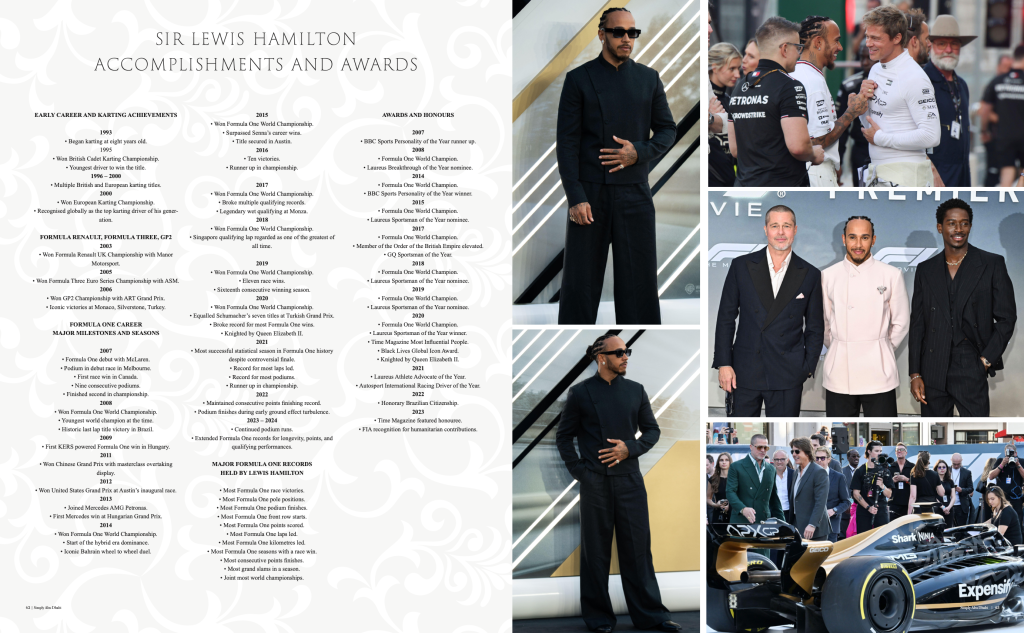
SIR LEWIS HAMILTON
AI-assisted voice playback. Starts only when you choose Play.
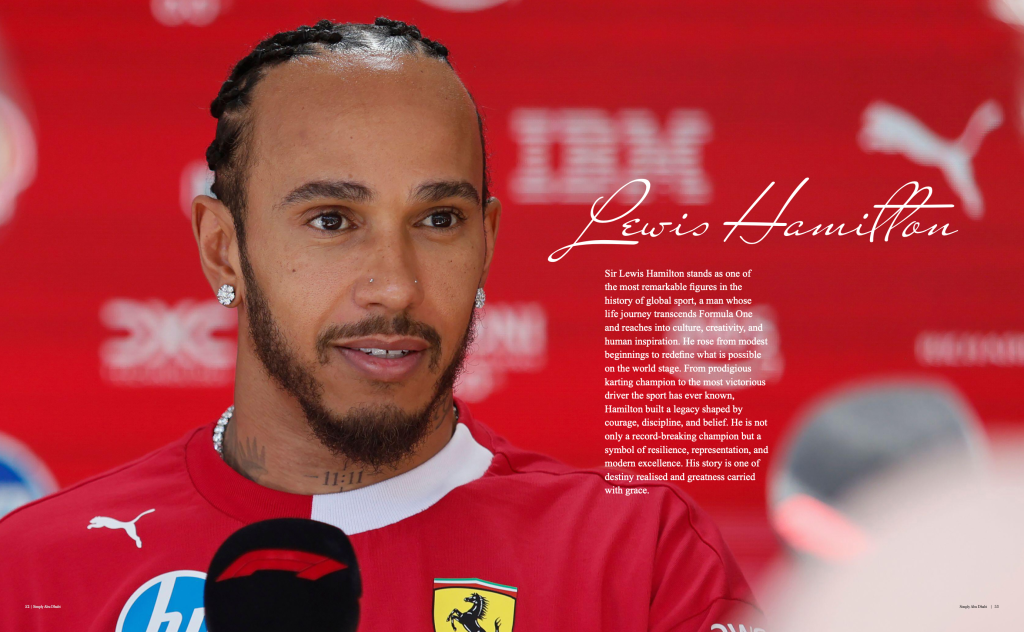
Sir Lewis Hamilton stands as one of the most remarkable figures in the history of global sport, a man whose life journey transcends Formula One and reaches into culture, creativity, and human inspiration. He rose from modest beginnings to redefine what is possible on the world stage. From prodigious karting champion to the most victorious driver the sport has ever known, Hamilton built a legacy shaped by courage, discipline, and belief. He is not only a record-breaking champion but a symbol of resilience, representation, and modern excellence. His story is one of destiny realised and greatness carried with grace.
His early childhood was marked by warmth, resilience, and unwavering support from both parents. After his parents separated when he was two, Lewis lived with his mother until the age of twelve, along with his half-sisters Nicola and Samantha. Lewis then moved to live with his father Anthony, stepmother Linda, and his younger half-brother Nicolas, who later became a racing driver himself. His bond with his father is legendary within motorsport history.
Anthony worked multiple jobs, including roles as a computer systems engineer, an information technology contractor, and at times managed a series of side jobs in order to support his son’s expensive dream. Lewis famously said, “My dad never gave up. He worked four jobs at one point so that I could chase my dream. Everything I am is because he never stopped believing.”
Lewis began karting at eight years old. His father bought a used kart and maintained it himself to save costs. Anthony acted as mechanic, manager, financier, coach, and protector. Their schedule became relentless. Lewis would attend school during the week, complete homework in the back of the car, travel to circuits across the country every weekend, sleep in cold paddocks, and rise before dawn. He recalled, “I remember staying in a tiny caravan with my dad and brother. It was freezing. But I loved every second because I knew that karting was where I belonged.”
From the very beginning he was fearless. He attacked corners with an intensity that other children found intimidating. His race craft evolved rapidly, marked by clinical overtakes and the rare ability to combine aggression with precision. He began winning local races with unusual consistency. The racing community took notice. His father kept detailed records of every cost, every race, and every result. He was building not just a young driver, but a future champion.
At ten years old, Lewis approached McLaren team principal Ron Dennis at the Autosport Awards in 1995. Wearing a smart suit, holding remarkable composure for a child, he introduced himself and declared his dream boldly. “Hi. I am Lewis Hamilton. I want to race for McLaren one day.”
Ron Dennis wrote in Lewis’s autograph book, “Phone me in nine years. We will sort something out”. This moment has since become one of the most iconic origin stories in elite sport. Ron later remarked, “Lewis had an aura. Some drivers have speed. Some have confidence. Lewis had both, and something more.”
Lewis dominated British karting through the mid- and late 1990s. He won the British Cadet Karting Championship in 1995 and became the youngest driver to do so. His talent became impossible to overlook. By 1997 Ron Dennis and McLaren, backed by Mercedes, signed Lewis to the most comprehensive young driver development programme ever offered to a British karter. Lewis described it as “the moment that changed my life forever”. From this point onwards, McLaren and Mercedes would fund his racing career through the junior formulae.
His karting achievements began to expand into Europe. He won multiple titles, including the European Karting Championship and the World Karting Championship phases where he battled and consistently defeated future Formula One rivals such as Nico Rosberg. Mechanics who worked with him described his mindset as almost unnervingly calm.
One recalled, “He had the focus of a grown champion when he was still a kid. When he sat in the kart, he changed. He became a warrior.”
By the year 2000 he was considered the greatest British karting prodigy of his generation. Global racing insiders followed his progress. Formula One figures whispered that a future champion was rising. Lewis, however, remained grounded by his father’s discipline, by the necessity of working twice as hard as others, and by the clear understanding that funding was limited. Every race mattered. He once revealed, “I knew as a kid that if I did not perform, we could not continue. So I learned to deliver under pressure from the very beginning.”
The boy from Stevenage had already climbed higher than many would ever reach. Yet his journey had only just begun. What followed would redefine the history of motorsport.
THE RISE THROUGH THE JUNIOR FORMULAS
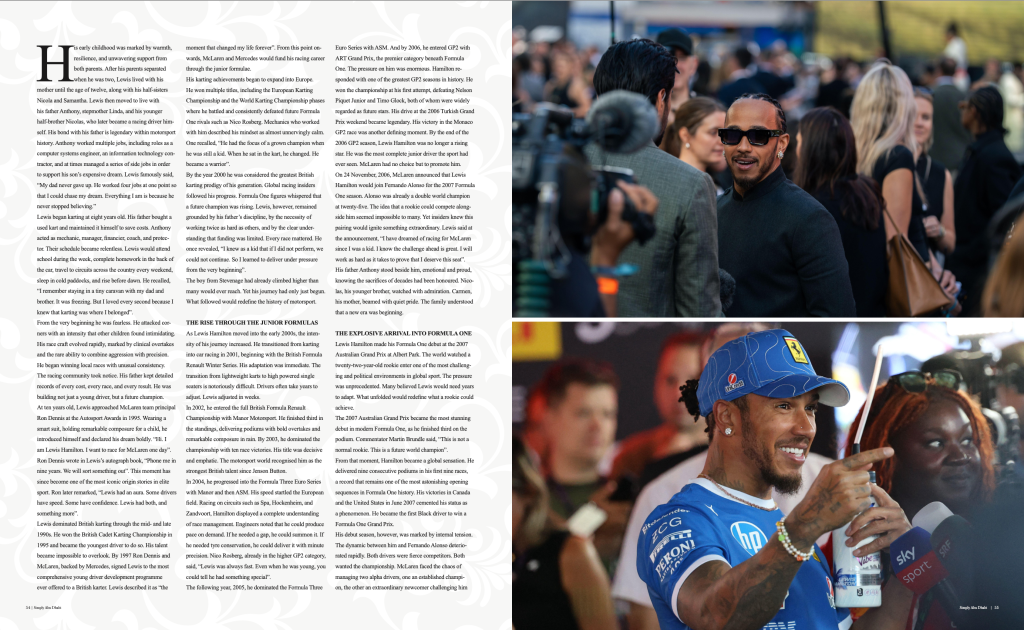
As Lewis Hamilton moved into the early 2000s, the intensity of his journey increased. He transitioned from karting into car racing in 2001, beginning with the British Formula Renault Winter Series. His adaptation was immediate. The transition from lightweight karts to high powered single seaters is notoriously difficult. Drivers often take years to adjust. Lewis adjusted in weeks.
In 2002, he entered the full British Formula Renault Championship with Manor Motorsport. He finished third in the standings, delivering podiums with bold overtakes and remarkable composure in rain. By 2003, he dominated the championship with ten race victories. His title was decisive and emphatic. The motorsport world recognised him as the strongest British talent since Jenson Button.
In 2004, he progressed into the Formula Three Euro Series with Manor and then ASM. His speed startled the European field. Racing on circuits such as Spa, Hockenheim, and Zandvoort, Hamilton displayed a complete understanding of race management. Engineers noted that he could produce pace on demand. If he needed a gap, he could summon it. If he needed tyre conservation, he could deliver it with minute precision.
Nico Rosberg, already in the higher GP2 category, said, “Lewis was always fast. Even when he was young, you could tell he had something special.”
The following year, 2005, he dominated the Formula Three Euro Series with ASM. And by 2006, he entered GP2 with ART Grand Prix, the premier category beneath Formula One. The pressure on him was enormous. Hamilton responded with one of the greatest GP2 seasons in history. He won the championship at his first attempt, defeating Nelson Piquet Junior and Timo Glock, both of whom were widely regarded as future stars.
His drive at the 2006 Turkish Grand Prix weekend became legendary. His victory in the Monaco GP2 race was another defining moment. By the end of the 2006 GP2 season, Lewis Hamilton was no longer a rising star. He was the most complete junior driver the sport had ever seen. McLaren had no choice but to promote him.
On 24 November 2006, McLaren announced that Lewis Hamilton would join Fernando Alonso for the 2007 Formula One season. Alonso was already a double world champion at twenty-five. The idea that a rookie could compete alongside him seemed impossible to many. Yet insiders knew this pairing would ignite something extraordinary.
Lewis said at the announcement, “I have dreamed of racing for McLaren since I was a kid. I know the challenge ahead is great. I will work as hard as it takes to prove that I deserve this seat.”
His father Anthony stood beside him, emotional and proud, knowing the sacrifices of decades had been honoured. Nicolas, his younger brother, watched with admiration. Carmen, his mother, beamed with quiet pride. The family understood that a new era was beginning.
THE EXPLOSIVE ARRIVAL INTO FORMULA ONE
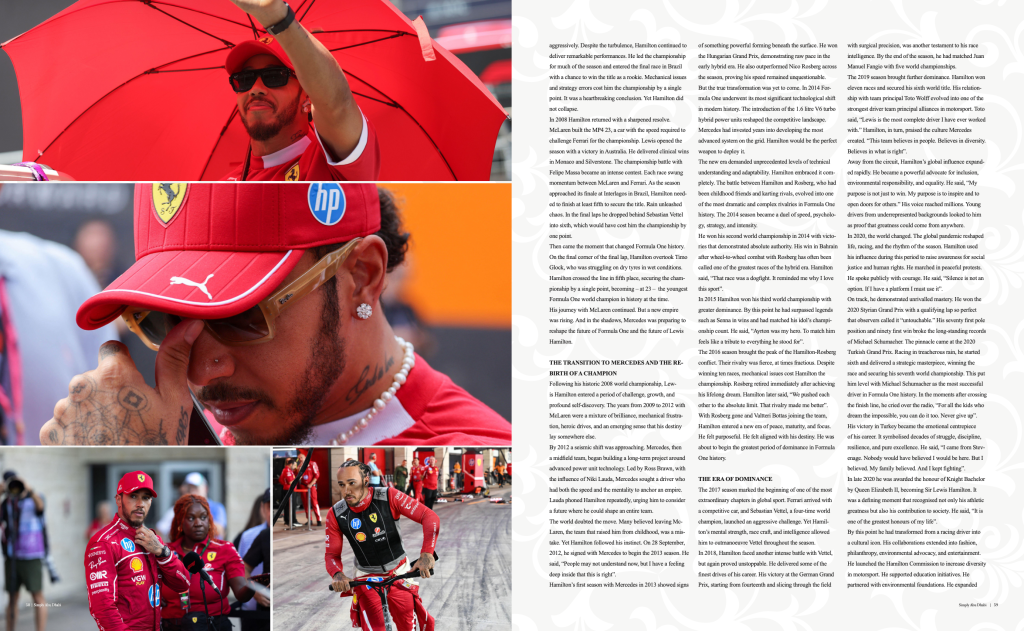
Lewis Hamilton made his Formula One debut at the 2007 Australian Grand Prix at Albert Park. The world watched a twenty-two-year-old rookie enter one of the most challenging and political environments in global sport. The pressure was unprecedented. Many believed Lewis would need years to adapt. What unfolded would redefine what a rookie could achieve.
The 2007 Australian Grand Prix became the most stunning debut in modern Formula One, as he finished third on the podium. Commentator Martin Brundle said, “This is not a normal rookie. This is a future world champion”.
From that moment, Hamilton became a global sensation. He delivered nine consecutive podiums in his first nine races, a record that remains one of the most astonishing opening sequences in Formula One history. His victories in Canada and the United States in June 2007 cemented his status as a phenomenon. He became the first Black driver to win a Formula One Grand Prix.
His debut season, however, was marked by internal tension. The dynamic between him and Fernando Alonso deteriorated rapidly. Both drivers were fierce competitors. Both wanted the championship. McLaren faced the chaos of managing two alpha drivers, one an established champion, the other an extraordinary newcomer challenging him aggressively.
Despite the turbulence, Hamilton continued to deliver remarkable performances. He led the championship for much of the season and entered the final race in Brazil with a chance to win the title as a rookie. Mechanical issues and strategy errors cost him the championship by a single point. It was a heartbreaking conclusion. Yet Hamilton did not collapse.
In 2008 Hamilton returned with a sharpened resolve. McLaren built the MP4-23, a car with the speed required to challenge Ferrari for the championship. Lewis opened the season with a victory in Australia. He delivered clinical wins in Monaco and Silverstone. The championship battle with Felipe Massa became an intense contest. Each race swung momentum between McLaren and Ferrari.
As the season approached its finale at Interlagos in Brazil, Hamilton needed to finish at least fifth to secure the title. Rain unleashed chaos. In the final laps he dropped behind Sebastian Vettel into sixth, which would have cost him the championship by one point.
Then came the moment that changed Formula One history.
On the final corner of the final lap, Hamilton overtook Timo Glock, who was struggling on dry tyres in wet conditions. Hamilton crossed the line in fifth place, securing the championship by a single point, becoming — at 23 — the youngest Formula One world champion in history at the time.
His journey with McLaren continued. But a new empire was rising. And in the shadows, Mercedes was preparing to reshape the future of Formula One and the future of Lewis Hamilton.
THE TRANSITION TO MERCEDES AND THE REBIRTH OF A CHAMPION
Following his historic 2008 world championship, Lewis Hamilton entered a period of challenge, growth, and profound self-discovery. The years from 2009 to 2012 with McLaren were a mixture of brilliance, mechanical frustration, heroic drives, and an emerging sense that his destiny lay somewhere else.
By 2012 a seismic shift was approaching. Mercedes, then a midfield team, began building a long-term project around advanced power unit technology. Led by Ross Brawn, with the influence of Niki Lauda, Mercedes sought a driver who had both the speed and the mentality to anchor an empire.
Lauda phoned Hamilton repeatedly, urging him to consider a future where he could shape an entire team. The world doubted the move. Many believed leaving McLaren, the team that raised him from childhood, was a mistake. Yet Hamilton followed his instinct.
On 28 September 2012, he signed with Mercedes to begin the 2013 season. He said, “People may not understand now, but I have a feeling deep inside that this is right”.
Hamilton’s first season with Mercedes in 2013 showed signs of something powerful forming beneath the surface. He won the Hungarian Grand Prix, demonstrating raw pace in the early hybrid era. He also outperformed Nico Rosberg across the season, proving his speed remained unquestionable.
But the true transformation was yet to come.
In 2014 Formula One underwent its most significant technological shift in modern history. The introduction of the 1.6 litre V6 turbo hybrid power units reshaped the competitive landscape. Mercedes had invested years into developing the most advanced system on the grid. Hamilton would be the perfect weapon to deploy it.
The new era demanded unprecedented levels of technical understanding and adaptability. Hamilton embraced it completely. The battle between Hamilton and Rosberg, who had been childhood friends and karting rivals, evolved into one of the most dramatic and complex rivalries in Formula One history.
The 2014 season became a duel of speed, psychology, strategy, and intensity.
He won his second world championship in 2014 with victories that demonstrated absolute authority. His win in Bahrain after wheel-to-wheel combat with Rosberg has often been called one of the greatest races of the hybrid era. Hamilton said, “That race was a dogfight. It reminded me why I love this sport”.
In 2015 Hamilton won his third world championship with greater dominance. By this point he had surpassed legends such as Senna in wins and had matched his idol’s championship count. He said, “Ayrton was my hero. To match him feels like a tribute to everything he stood for”.
The 2016 season brought the peak of the Hamilton-Rosberg conflict. Their rivalry was fierce, at times fractious. Despite winning ten races, mechanical issues cost Hamilton the championship. Rosberg retired immediately after achieving his lifelong dream.
Hamilton later said, “We pushed each other to the absolute limit. That rivalry made me better”.
With Rosberg gone and Valtteri Bottas joining the team, Hamilton entered a new era of peace, maturity, and focus. He felt purposeful. He felt aligned with his destiny. He was about to begin the greatest period of dominance in Formula One history.
THE ERA OF DOMINANCE
The 2017 season marked the beginning of one of the most extraordinary chapters in global sport. Ferrari arrived with a competitive car, and Sebastian Vettel, a four-time world champion, launched an aggressive challenge. Yet Hamilton’s mental strength, race craft, and intelligence allowed him to outmanoeuvre Vettel throughout the season.
In 2018, Hamilton faced another intense battle with Vettel, but again proved unstoppable. He delivered some of the finest drives of his career. His victory at the German Grand Prix, starting from fourteenth and slicing through the field with surgical precision, was another testament to his race intelligence.
By the end of the season, he had matched Juan Manuel Fangio with five world championships.
The 2019 season brought further dominance. Hamilton won eleven races and secured his sixth world title. His relationship with team principal Toto Wolff evolved into one of the strongest driver team principal alliances in motorsport. Toto said, “Lewis is the most complete driver I have ever worked with.”
Hamilton, in turn, praised the culture Mercedes created. “This team believes in people. Believes in diversity. Believes in what is right”.
Away from the circuit, Hamilton’s global influence expanded rapidly. He became a powerful advocate for inclusion, environmental responsibility, and equality. He said, “My purpose is not just to win. My purpose is to inspire and to open doors for others.”
His voice reached millions. Young drivers from underrepresented backgrounds looked to him as proof that greatness could come from anywhere.
In 2020, the world changed. The global pandemic reshaped life, racing, and the rhythm of the season. Hamilton used his influence during this period to raise awareness for social justice and human rights. He marched in peaceful protests. He spoke publicly with courage. He said, “Silence is not an option. If I have a platform I must use it”.
On track, he demonstrated unrivalled mastery. He won the 2020 Styrian Grand Prix with a qualifying lap so perfect that observers called it “untouchable”. His seventy first pole position and ninety first win broke the long-standing records of Michael Schumacher.
The pinnacle came at the 2020 Turkish Grand Prix. Racing in treacherous rain, he started sixth and delivered a strategic masterpiece, winning the race and securing his seventh world championship. This put him level with Michael Schumacher as the most successful driver in Formula One history.
In the moments after crossing the finish line, he cried over the radio, “For all the kids who dream the impossible, you can do it too. Never give up”.
His victory in Turkey became the emotional centrepiece of his career. It symbolised decades of struggle, discipline, resilience, and pure excellence. He said, “I came from Stevenage. Nobody would have believed I would be here. But I believed. My family believed. And I kept fighting”.
In late 2020 he was awarded the honour of Knight Bachelor by Queen Elizabeth II, becoming Sir Lewis Hamilton. It was a defining moment that recognised not only his athletic greatness but also his contribution to society. He said, “It is one of the greatest honours of my life”.
By this point he had transformed from a racing driver into a cultural icon. His collaborations extended into fashion, philanthropy, environmental advocacy, and entertainment. He launched the Hamilton Commission to increase diversity in motorsport. He supported education initiatives. He partnered with environmental foundations. He expanded his mission beyond the track, stating, “Legacy is not about trophies. It is about impact”.
Even as he reached the greatest heights the sport had ever seen, Hamilton remained hungry, committed, and spiritually aligned with his purpose. He evolved into a multidimensional figure who transcended Formula One. He became a symbol of excellence, empathy, and cultural influence. The world recognised him as not only an extraordinary athlete but also a humanitarian, a creative visionary, and a leader in global conversations.
THE CONTROVERSY OF 2021 AND THE EVOLUTION OF A GLOBAL ICON
After achieving his seventh world championship in 2020, Sir Lewis Hamilton entered the 2021 Formula One season with a sense of spiritual calm and competitive fire. He was now the most decorated driver in the history of the sport.
Yet there remained a powerful target ahead. The possibility of an unprecedented eighth world championship. A new era challenger emerged in Max Verstappen, backed by a revitalised Red Bull team led by Christian Horner and powered by Adrian Newey’s aerodynamic genius.
Hamilton embraced the challenge. He said, “Pressure is a privilege. If the mountain is higher, I will climb higher”.
The season quickly became one of the most intense and emotionally charged championship battles in Formula One history. The rivalry ignited at Silverstone. During the first lap at Copse Corner the two title contenders collided at high speed. The incident divided the global fanbase, and the season became a psychological war as much as a technical competition.
Hamilton displayed his trademark composure throughout. His performance in Brazil became an immortal moment. After being disqualified from qualifying for a technical infringement unrelated to driver performance, he started the sprint race from twentieth. He executed one of the greatest comeback drives in the history of the sport, gaining fifteen positions.
The next day he took a five-place grid penalty and started tenth for the Grand Prix. He overtook the entire field and passed Verstappen in a decisive wheel to wheel battle to win.
Commentator David Croft said, “This is one of the greatest drives we will ever see.”
The championship decider in Abu Dhabi at Yas Marina on 12 December 2021 became the most controversial race in Formula One history. Hamilton dominated the race, managing tyres, pace, and pressure. With five laps remaining he held a comfortable lead, on course to secure his eighth world championship.
A late safety car transformed the race. Confusion around the interpretation of the rules governing lapped cars changed the outcome. Verstappen received a final lap restart directly behind Hamilton on fresh tyres. After the restart Hamilton had no realistic defence. Verstappen passed him on turn five and won the race.
The world watched in disbelief. Hamilton handled the outcome with extraordinary dignity. In the immediate aftermath he said, “Congratulations to Max. He did what he had to do. But to my team, I am so proud of you. Everyone stay positive. We gave everything”.
The 2022 season brought new regulations. The ground effect cars created bouncing issues known as porpoising, and Mercedes struggled with the new technical era. Hamilton said, “This season has been a challenge unlike any other. But I will never give up.”
His leadership held the team together. His mentorship of George Russell became a highlight. The two drivers worked closely to develop the car, with mutual respect. Hamilton delivered heroic performances despite a difficult car. His drives at Silverstone, Barcelona, and Austin demonstrated his ability to extract miracles from limitations.
In 2023 and 2024, Hamilton continued to push relentlessly while Mercedes worked to regain its competitiveness. His consistency, race craft, and precision kept him among the elite. He continued to break records, extend his streak of consecutive points scoring finishes, and demonstrate commitment at an age when many drivers retire.
He said, “Age does not define me. Purpose defines me”.
Off track his influence deepened. Hamilton expanded his philanthropic work. He collaborated with world leading designers, partnered with global sustainability projects, and served as an inspirational figure across sport, fashion, education, and social transformation.
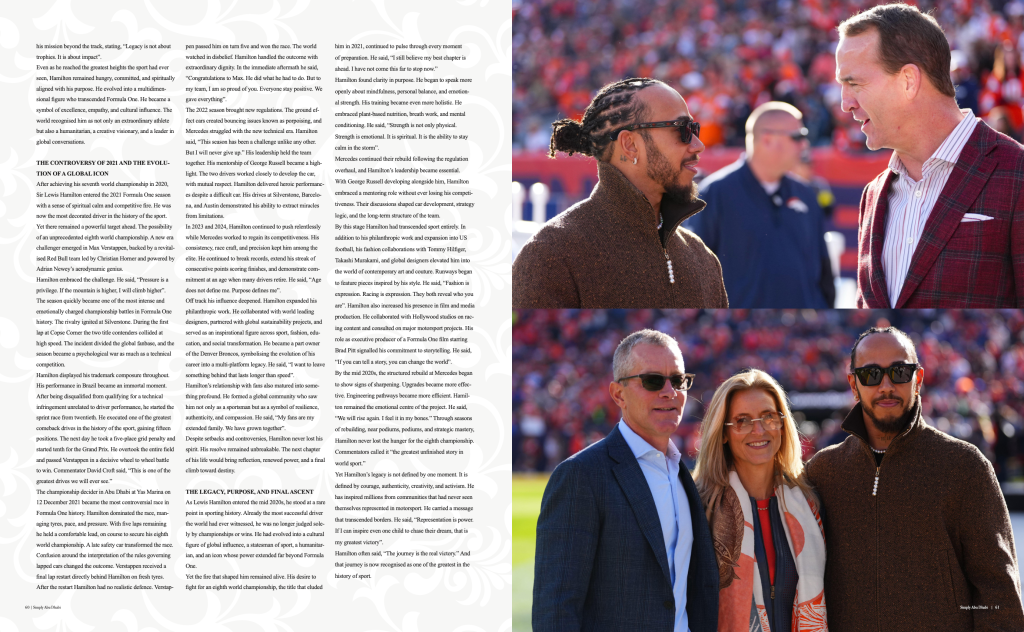
He became a part owner of the Denver Broncos, symbolising the evolution of his career into a multi-platform legacy. He said, “I want to leave something behind that lasts longer than speed”.
Hamilton’s relationship with fans also matured into something profound. He formed a global community who saw him not only as a sportsman but as a symbol of resilience, authenticity, and compassion. He said, “My fans are my extended family. We have grown together”.
Despite setbacks and controversies, Hamilton never lost his spirit. His resolve remained unbreakable. The next chapter of his life would bring reflection, renewed power, and a final climb toward destiny.
THE LEGACY, PURPOSE, AND FINAL ASCENT
As Lewis Hamilton entered the mid 2020s, he stood at a rare point in sporting history. Already the most successful driver the world had ever witnessed, he was no longer judged solely by championships or wins. He had evolved into a cultural figure of global influence, a statesman of sport, a humanitarian, and an icon whose power extended far beyond Formula One.
Yet the fire that shaped him remained alive. His desire to fight for an eighth world championship, the title that eluded him in 2021, continued to pulse through every moment of preparation. He said, “I still believe my best chapter is ahead. I have not come this far to stop now.”
Hamilton found clarity in purpose. He began to speak more openly about mindfulness, personal balance, and emotional strength. His training became even more holistic. He embraced plant-based nutrition, breath work, and mental conditioning.
He said, “Strength is not only physical. Strength is emotional. It is spiritual. It is the ability to stay calm in the storm”.
Mercedes continued their rebuild following the regulation overhaul, and Hamilton’s leadership became essential. With George Russell developing alongside him, Hamilton embraced a mentoring role without ever losing his competitiveness. Their discussions shaped car development, strategy logic, and the long-term structure of the team.
By this stage Hamilton had transcended sport entirely. In addition to his philanthropic work and expansion into US football, his fashion collaborations with Tommy Hilfiger, Takashi Murakami, and global designers elevated him into the world of contemporary art and couture.
Runways began to feature pieces inspired by his style. He said, “Fashion is expression. Racing is expression. They both reveal who you are”.
Hamilton also increased his presence in film and media production. He collaborated with Hollywood studios on racing content and consulted on major motorsport projects. His role as executive producer of a Formula One film starring Brad Pitt signalled his commitment to storytelling.
He said, “If you can tell a story, you can change the world”.
By the mid 2020s, the structured rebuild at Mercedes began to show signs of sharpening. Upgrades became more effective. Engineering pathways became more efficient. Hamilton remained the emotional centre of the project.
He said, “We will rise again. I feel it in my bones.”
Through seasons of rebuilding, near podiums, podiums, and strategic mastery, Hamilton never lost the hunger for the eighth championship. Commentators called it “the greatest unfinished story in world sport.”
Yet Hamilton’s legacy is not defined by one moment. It is defined by courage, authenticity, creativity, and activism. He has inspired millions from communities that had never seen themselves represented in motorsport.
He carried a message that transcended borders. He said, “Representation is power. If I can inspire even one child to chase their dream, that is my greatest victory”.
Hamilton often said, “The journey is the real victory.”
And that journey is now recognised as one of the greatest in the history of sport.