
FERRAGAMO FALL-WINTER 2026 REVISITS THE HOUSE’S OBSESSION WITH SHOES
Ferragamo’s Fall-Winter 2026 campaign places the shoe at the centre of a surreal visual world shaped by heritage, fashion and contemporary art. Through Johnny Dufort’s lens, Maximilian Davis revisits one of the house’s defining preoccupations, turning an enduring fascination with footwear into a study of desire and imagination.
AI-assisted voice playback. Starts only when you choose Play.
Few objects occupy as complicated a place within fashion as the shoe. Functional by nature but capable of carrying extraordinary cultural and emotional weight, it has long served as a canvas for craftsmanship, fantasy and identity. For Ferragamo, that relationship is particularly deep. The house’s Fall-Winter 2026 campaign returns to its longstanding fascination with footwear, presenting shoes not simply as accessories but as objects capable of shaping an entire visual universe.
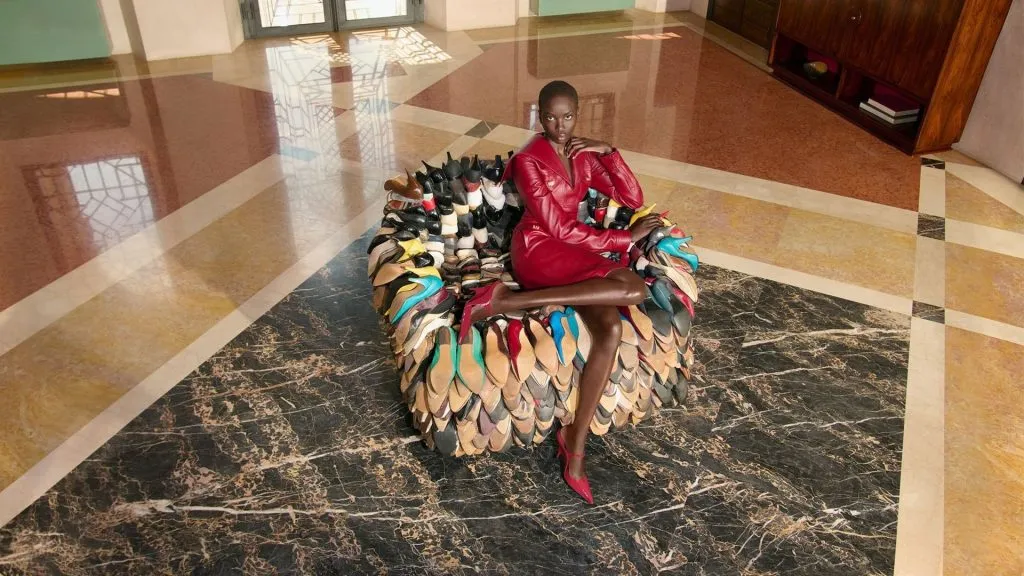
Under the creative direction of Maximilian Davis, the campaign revisits a recurring Ferragamo motif: women surrounded by an abundance of shoes. Photographer and director Johnny Dufort brings the idea into a contemporary setting, creating imagery that balances fashion with a distinctly imaginative quality. The result is neither a straightforward celebration of heritage nor a literal recreation of archival imagery. Instead, the familiar Ferragamo vocabulary is treated as material for a new interpretation.
The campaign’s premise is deliberately simple. Shoes become the starting point, while the surrounding world allows their meaning to expand. Anok Yai, Vittoria Ceretti and Thibaud Charon appear alongside global brand ambassadors Jingyu Huang and Ning Chang, with styling by Lotta Volkova. Dufort’s perspective gives the images a sense of movement and visual intrigue, allowing the abundance of footwear to feel less like a conventional product display and more like a collection of objects gathered around a shared fascination.
That fascination has deep roots in Ferragamo’s history. Salvatore Ferragamo established his first company in Florence in 1927, concentrating on the study, creation, manufacture and sale of women’s footwear. His relationship with shoes had already taken him from Italy to the United States, where he opened the Hollywood Boot Shop in 1923 and developed a reputation for creating footwear for film stars. His return to Florence marked the beginning of the business that would grow into the Ferragamo house, combining the city’s artisanal traditions with the technical experimentation he had developed in America.
Footwear remained at the heart of that evolution. Ferragamo became known for approaching the construction of a shoe through both engineering and aesthetics, developing techniques and forms that addressed the relationship between the foot and the finished design. Among his best-known innovations was the cork wedge heel, patented in 1937, while the following year brought the Rainbow sandal created for Judy Garland. His work with Hollywood clients had already established a connection between footwear and celebrity, an association that would remain embedded in the house’s identity.
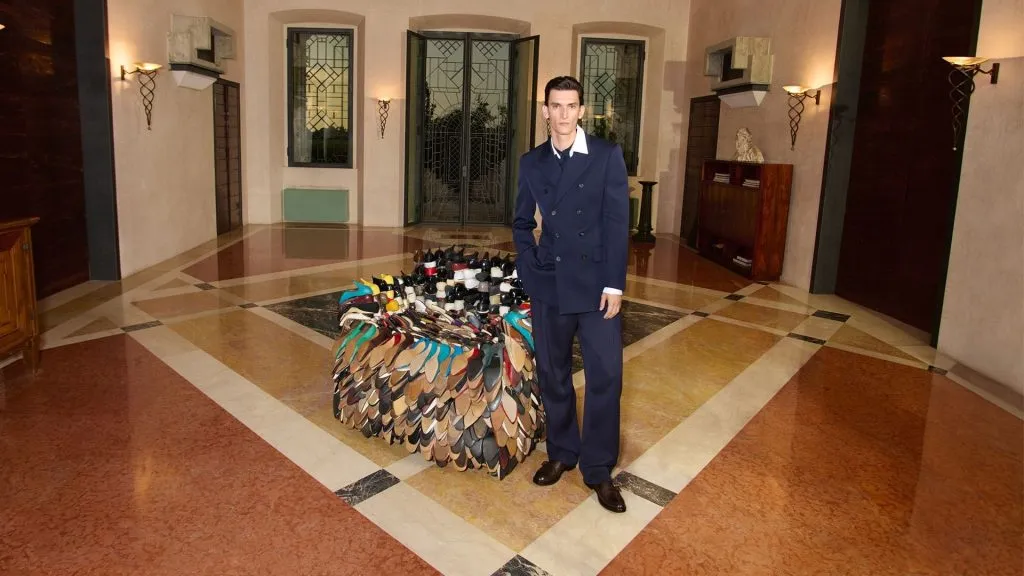
The Fall-Winter 2026 campaign draws on that history without attempting to replicate it. Its visual language instead places the house’s shoe obsession within a broader contemporary conversation between fashion and art. A key presence within the campaign is American artist Willie Cole’s Made in the Philippines IV, created in 1994 and presented courtesy of Museum Voorlinden in Wassenaar, the Netherlands.
Cole’s sculpture introduces another layer to the campaign’s exploration of objects, transformation and visual association. Its inclusion shifts the imagery away from a purely fashion-driven narrative, suggesting a dialogue between the manufactured object and the artistic object. In that setting, Ferragamo’s shoes become part of a larger composition in which form, material and repetition matter as much as their original purpose.
The artistic connection is consistent with a relationship that has been part of Ferragamo’s identity since the founder’s return to Florence. The city’s artistic heritage and its community of craftspeople influenced Salvatore Ferragamo’s approach to design, while the company has continued to maintain a relationship with art and cultural preservation. The Museo Salvatore Ferragamo, housed in the historic Palazzo Spini Feroni in Florence, occupies a building that became closely connected to the company after Ferragamo established his workshop there in 1938 and later purchased the palazzo.
That connection between past and present is particularly relevant to Davis’s Fall-Winter 2026 collection. Ferragamo’s official presentation describes the season as a return to the artistic and cultural atmosphere of the 1920s, the decade in which the house was established. Davis draws from the era’s sense of liberation through the idea of the speakeasy, creating a tension between utilitarian discipline and a more liberated elegance. Historical techniques are considered alongside contemporary silhouettes and experimental textures, allowing the collection to acknowledge its origins without becoming bound by them.
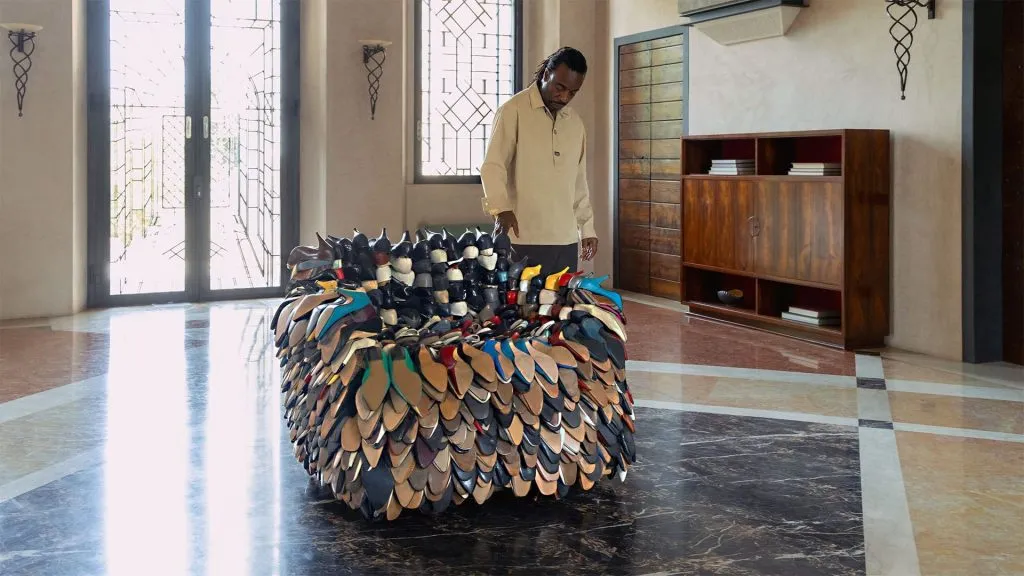
The campaign consequently operates on two levels. At its surface is the pleasure of looking at shoes: their shapes, accumulation and visual magnetism. Beneath that is a consideration of why footwear has held such a powerful position within Ferragamo for almost a century. A shoe can be sculptural, technical, sensual or playful, sometimes all at once. By surrounding its protagonists with an abundance of footwear, Dufort’s imagery exaggerates that fascination until the shoe becomes almost architectural within the frame.
The campaign’s creative team reinforces its fashion credentials. Baron & Baron serves as creative agency, while Dufort takes on both photography and direction and Volkova brings her distinctive styling perspective. Together, the collaborators create a visual language that allows Ferragamo’s established codes to feel less archival and more fluid.
The house has expanded considerably since its origins in Florentine footwear. Its collections now encompass leather goods, ready-to-wear, silk products and accessories for both women and men, alongside licensed eyewear, watches and fragrances. Yet footwear remains a defining part of its heritage and creative identity. Ferragamo’s own history records the opening of its first directly operated stores in Florence and Rome in 1938, followed by international expansion across Europe, Asia, the Americas and beyond, with a presence in major luxury markets worldwide.
For Fall-Winter 2026, Ferragamo does not need to manufacture a new relationship with the shoe. It already possesses one of fashion’s richest histories of footwear as craft, innovation and cultural expression. By returning to that obsession through Johnny Dufort’s lens, the house allows an old fascination to become visually unfamiliar again. The shoes remain at the centre, but the campaign asks us to look at them differently — as objects whose appeal lies as much in what they suggest as in what they are.