
Alaïa Commissions Guan Xiao Sculpture: Where Ancient Artefact Meets Contemporary Form
AI-assisted voice playback. Starts only when you choose Play.
Alaïa has long understood that a maison devoted to the architecture of the body need not limit itself to cloth and seam. The French fashion house's enduring commitment to the visual arts has produced a succession of installations and commissions that probe the same territory: how form engages space, how materials reveal themselves, and how rigorous construction becomes its own language.
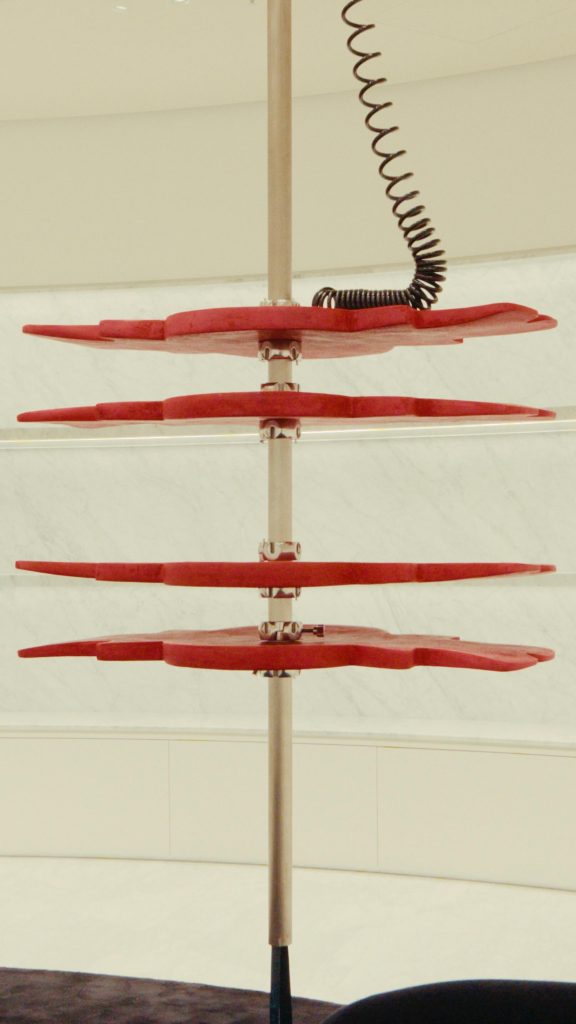
The latest chapter in that dialogue arrives now at Plaza 66 in Shanghai, where a monumental new sculpture by Chinese artist Guan Xiao inhabits the Alaïa boutique. Titled *Things I Couldn't Forget — Nose Ornament, Quimbaya, Colombia*, the work represents both a continuation of that curatorial vision and a genuine convergence between two distinct practices bound by a shared obsession with material intelligence.
Collage as Language
Guan Xiao's artistic methodology rests on what might be termed sculptural collage—a deliberate juxtaposition of materials, historical references and visual vocabularies that resist any single interpretive frame. Her practice spans sculpture, installation and video, each medium animated by the same principle: heterogeneous elements brought into unexpected dialogue.
In this commission, dyed fibreglass converges with spiral wire and stainless steel tubing, supplemented by industrial components that feel simultaneously functional and abstracted. The result is neither purely organic nor wholly technological, neither archaeological nor contemporary. Each register operates at full intensity, creating a tension that sustains rather than resolves itself.
The Quimbaya Reference
The work's title invokes the Quimbaya culture of pre-Columbian Colombia, whose master metallurgists created extraordinary ornamental objects of gold. By titling her sculpture as a nose ornament—referencing ceremonial adornment worn on the body—Guan Xiao establishes an immediate conversation with Alaïa's own preoccupation: the relationship between form and the human silhouette.
Yet this is not pastiche or appropriation. Rather, Guan Xiao treats the Quimbaya reference as one voice among many, allowing it to coexist with industrial materials and contemporary fabrication. The result speaks to her broader interest in how different historical and cultural contexts can occupy the same object without collapsing into meaning.
A Shared Sensibility
The affinity between Alaïa and Guan Xiao extends beyond aesthetic sympathy. Both practices are fundamentally rooted in construction—in the belief that how something is made is inseparable from what it means. Alaïa's fastidious attention to seaming, proportion and the sculpted line finds its parallel in Guan Xiao's commitment to material transformation and formal precision.
Where Alaïa channels sensuality through structure, achieving fluidity by means of rigorous tailoring, Guan Xiao creates forms that resist easy reading through the deliberate clash of contradictory materials and references. Both are practised in the art of holding tension: between softness and severity, between the body and the architectural, between what can be said and what must remain ambiguous.
The Shanghai installation marks a significant moment in Alaïa's ongoing dialogue with contemporary art—not as external validation or cultural aspiration, but as an extension of the house's core philosophy. In Guan Xiao's hands, the Quimbaya nose ornament becomes neither museum piece nor fashion statement, but something altogether more unsettling: a form that insists on the complexity and multiplicity of meaning itself.
That refusal to simplify, that insistence on material intelligence and structural thought, is precisely what draws Alaïa to artists of genuine substance. *Things I Couldn't Forget* now occupies the Shanghai boutique as a permanent meditation on how luxury—true luxury—resides not in the purity of a single idea, but in the rigorous, uncompromising pursuit of form.
Imagery is used for editorial purposes. All rights remain with the respective owners, photographers and licensors.
Imagery courtesy of ALAÏA (@maisonalaia).