
Prada Galleria: Eight Floors of Unified Luxury in Milan’s Most Iconic Arcade
AI-assisted voice playback. Starts only when you choose Play.
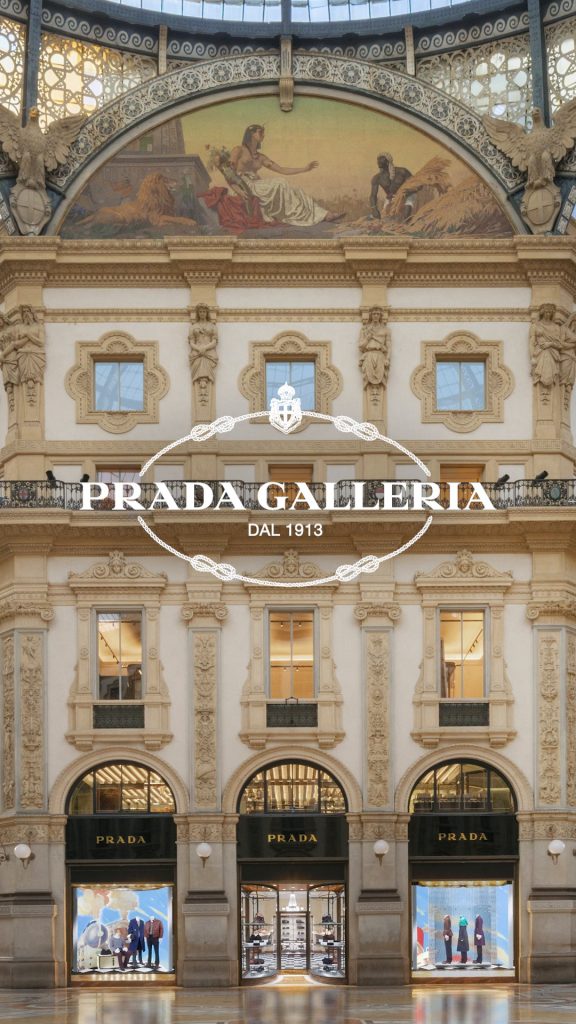
Prada has realised an architectural and conceptual ambition with the opening of its Galleria—a vertical universe spanning eight floors within the venerated Galleria Vittorio Emanuele II in Milan. Rather than a conventional flagship store, the project functions as a totality: retail, hospitality, art, and institutional knowledge coexist beneath a single envelope, each element informing the others.
The undertaking represents a departure from the branded monolith model that has long defined luxury retail. Instead, Prada has orchestrated distinct yet interconnected zones, each with its own purpose and character, that together articulate the full scope of the house's creative vision and heritage.
A Layered Proposition
The Galleria unfolds across eight distinct floors, each housing a different facet of the Prada ecosystem. Prada Donna and Prada Uomo occupy dedicated retail spaces, presenting the house's contemporary collections within environments designed to reflect their individual codes. Passaggio Segreto—the name itself evokes discovery and intimacy—functions as a curated passage through the project's narrative, whilst Marchesi 1824, Prada's historic patisserie and café, brings gastronomy into dialogue with fashion.
Beyond commerce, the structure incorporates Pradasphere, a space dedicated to immersive experience and cultural exchange; Studio, an operational hub where creative thinking is made visible; Appartamento, a residential-scaled environment that grounds the brand in the domestic sphere; and Osservatorio Fondazione Prada, which situates the house within a broader intellectual and artistic discourse. Together, these elements refuse the separation of luxury retail from culture, history, and daily life.
The Galleria Vittorio Emanuele II Context
The choice of location carries historical weight. The Galleria Vittorio Emanuele II, completed in 1877, stands as one of Europe's finest examples of 19th-century civic architecture—a glass-roofed arcade that has long served as Milan's cultural and commercial crossroads. By anchoring its Galleria within this landmark, Prada positions itself not as an interruption to the city's fabric, but as a contributor to its ongoing evolution.
The arcade has historically housed galleries, cafés, and boutiques that reflected Milan's status as a centre of taste and refinement. Prada's intervention respects that heritage whilst establishing a contemporary standard for what luxury retail and cultural space can accomplish in concert.
A Synthesis Without Precedent
Prada's framing of the Galleria as 'a synthesis of ideas, influences and history that exists, in this form, nowhere else' underscores its specificity. This is not a formula replicated across global cities; rather, it is conceived as an unrepeatable convergence of circumstance, location, and creative intention.
The project signals a shift in how established luxury houses approach their relationship with cities and with their audiences. Rather than presenting itself as a destination separate from civic life, Prada has engineered a permeable structure—one that welcomes the visitor, the resident, the scholar, and the casual pedestrian into an expanded definition of what the brand encompasses.
The Prada Galleria stands as an assertion that luxury, at its highest expression, transcends transactional exchange. It is a space designed to embed the brand within the city's cultural and social infrastructure, acknowledging that true refinement extends from product into experience, from commerce into community, and from the present moment into historical consciousness.
Imagery is used for editorial purposes. All rights remain with the respective owners, photographers and licensors.
Imagery courtesy of Prada (@prada).