
Piaget’s Architectural Cuff: Where Sculptural Geometry Meets High Jewellery
AI-assisted voice playback. Starts only when you choose Play.
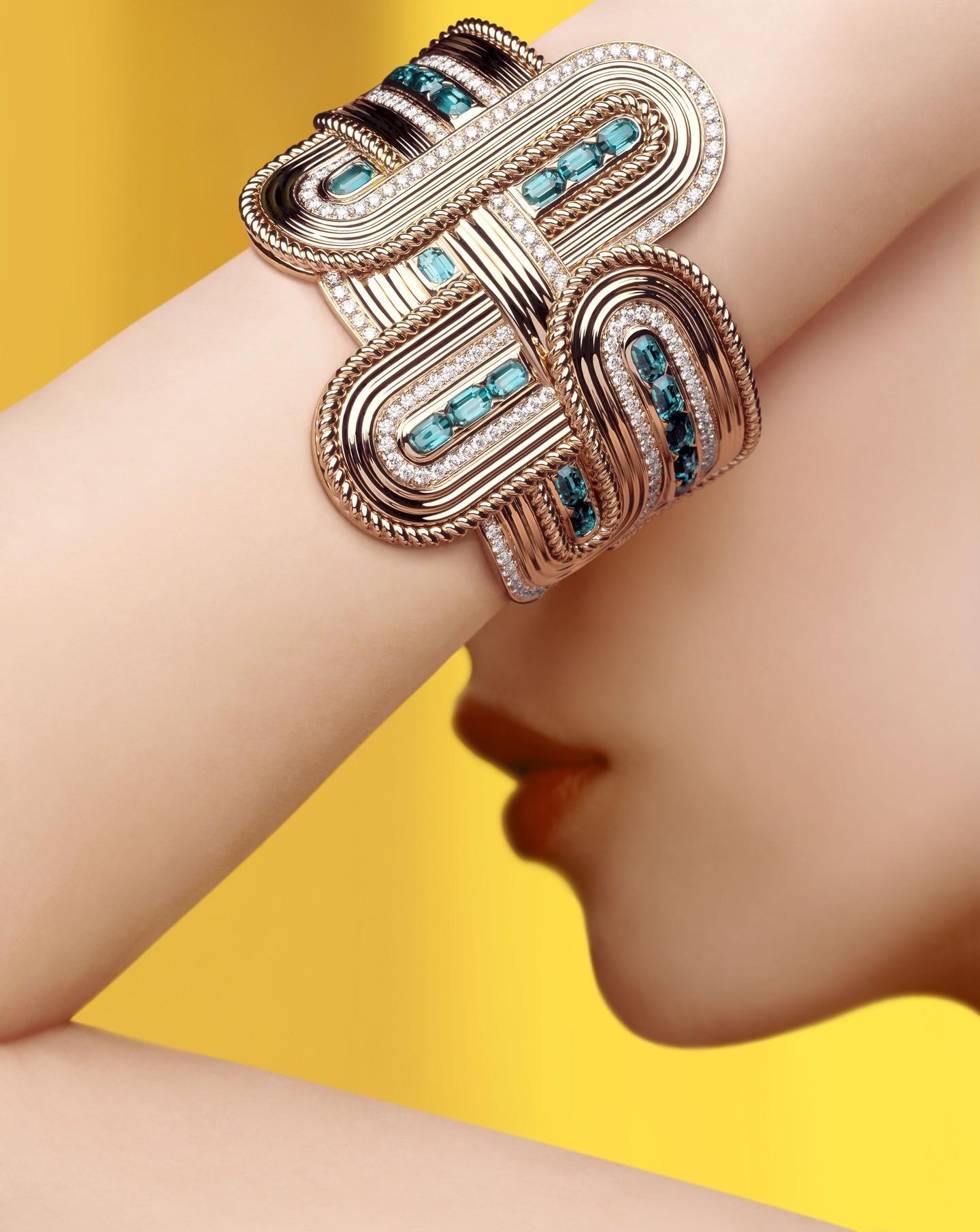
The relationship between architecture and jewellery has long fascinated designers working at the intersection of fine art and wearable luxury. Piaget's latest High Jewellery offering exemplifies this dialogue—a bracelet that treats the wrist as a canvas for geometric expression, where each element serves both aesthetic and structural purpose.
Unveiled in September 2026, this rose-gold cuff represents a departure from conventional bracelet design. Rather than embracing symmetry or linear progression, the piece adopts a labyrinthine structure that rewards sustained attention, encouraging the wearer to discover fresh details with each rotation of the wrist.
Design Language: The Art of Spatial Complexity
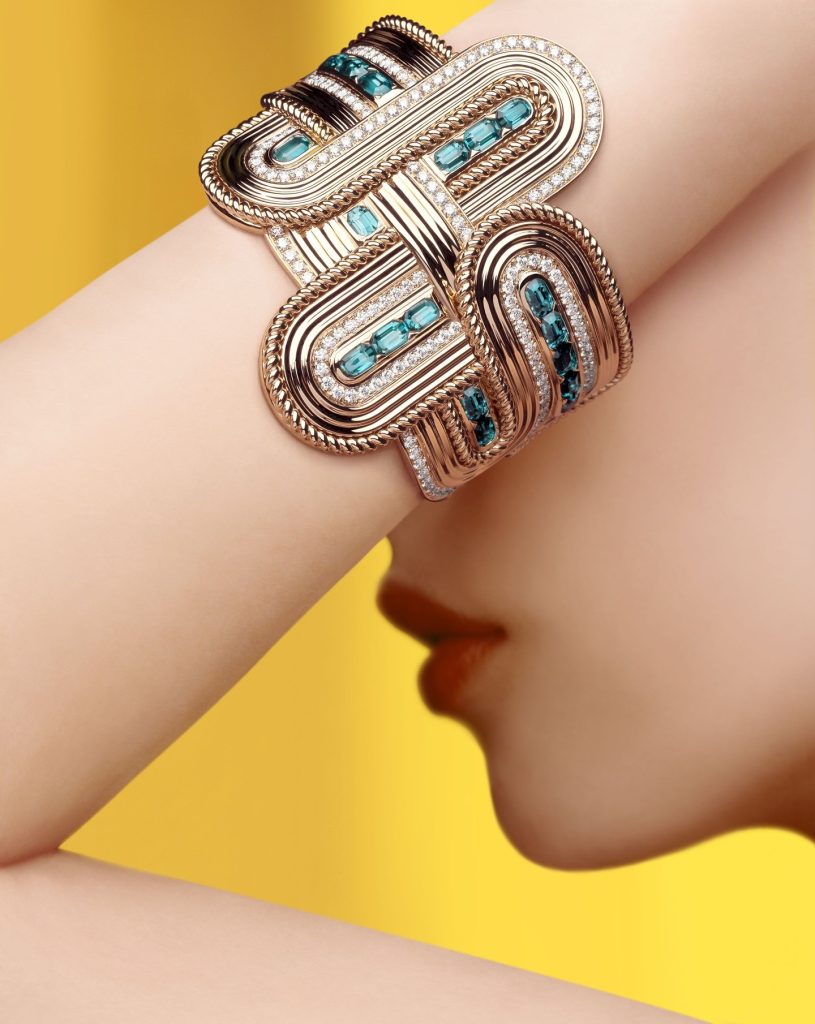
At its foundation, the cuff employs bold lines and sharp curves—a vocabulary that speaks to modernist principles whilst remaining distinctly contemporary. Rose gold, with its warm undertones and inherent luminosity, becomes the architectural scaffolding upon which the design unfolds. The metal's malleability allows artisans to execute the sharp transitions and sculptural volumes that define the piece.
The compositional strategy eschews predictability. Rather than a traditional bracelet silhouette, Piaget has created what might be described as a three-dimensional maze—a series of interlocking planes that shift perspective as they wrap around the wrist. This approach transforms the jewel from a static ornament into an object that evolves through movement and viewing angle, much in the manner of kinetic sculpture.
Gemstone Integration: Colour and Clarity
The jewellery's chromatic palette hinges upon a considered interplay between colourless diamonds and baguette-cut bluish-green tourmalines. These tourmalines—a semi-precious variety that has experienced considerable Renaissance among contemporary designers—introduce an unexpected colour note that grounds the otherwise maximalist composition.
Tourmaline's optical properties prove particularly suited to this design's intentions. The stone's tendency to reveal different shades depending on the angle of light complements the bracelet's multifaceted geometry. Baguette cutting, with its elongated rectangles, creates visual continuity through the sculptural pathways, whilst the diamonds—positioned to catch and refract light at multiple points—punctuate the composition with brilliance.
The calibration of these gemstones reflects high-level lapidary expertise. Each stone must align precisely with the metal's planes to maintain the overall visual coherence. This demands not merely technical precision but an understanding of how colour and light behave across a three-dimensional form.
Craftsmanship and the Piaget Tradition
Piaget's heritage in High Jewellery rests upon decades of expertise in translating conceptual boldness into wearable reality. The Swiss manufacture, established in the Vallée de Joux, has historically balanced technical innovation with aesthetic refinement—a combination evident in this latest commission.
The execution of such a complex design demands multiple stages of craftsmanship. Metalworkers must first construct the structural armature, ensuring that curves and angles align with mathematical precision. The subsequent stone-setting process requires comparative restraint—the gems must enhance rather than overwhelm the geometric narrative.
What distinguishes luxury High Jewellery from costume or commercial jewellery is precisely this integration of vision and execution. A design's ambition means nothing without the technical capacity to realise it. Piaget's decision to commission this piece suggests confidence in its ateliers' ability to manifest such architectural complexity at the highest standard.
The Labyrinth as Metaphor
The deliberate labyrinthine aesthetic carries implications beyond mere formal innovation. Labyrinths possess symbolic resonance—they suggest journey, discovery, and the pleasure of sustained exploration. In the context of jewellery worn close to the body, this geometry creates an intimate conversation between the wearer and the object.
Unlike jewellery designed for external admiration, this cuff invites constant tactile and visual engagement. The wearer becomes, in a sense, an explorer within the piece's own architecture. Companions and observers, too, find fresh visual information upon closer inspection—there is no single 'correct' way to view the bracelet.
This democratic approach to visual experience—wherein the wearer's perspective holds equal validity to the observer's—reflects contemporary luxury values, which increasingly prize dialogue and interaction over static display.
Contemporary Luxury in Rose Gold
Rose gold has transitioned from novelty to standard in contemporary jewellery, yet its particular qualities remain underexplored by many manufacturers. Its warmth—neither the cool formality of white gold nor the traditional luxury of yellow gold—offers emotional accessibility without sacrificing prestige. For Piaget, rose gold becomes the medium through which geometric complexity reads as approachable rather than austere.
The choice also reflects broader industry shifts towards coloured gold and alternative precious metals. Rising consciousness regarding mining and sustainability has encouraged designers to reconceive the traditional precious metal palette. Rose gold, derived from gold and copper, demonstrates that luxury need not adhere to monocolor uniformity.
This High Jewellery cuff represents jewellery as spatial experience rather than merely decorative object. By collapsing distinctions between architecture, sculpture, and wearable art, Piaget has created a piece that challenges conventional bracelet morphology whilst maintaining absolute technical refinement.
For collectors accustomed to conventional luxury jewellery, the piece offers intellectual engagement alongside material prestige. It asks the wearer and observer to reconsider what jewellery can express—and how geometry, colour, and light might combine to create an object worthy of sustained attention and lifetime wear.
Imagery is used for editorial purposes. All rights remain with the respective owners, photographers and licensors.
Imagery courtesy of Piaget (@piaget).