
ROLEX FOUR SEASONS: FOUR GEM-SET COSMOGRAPH DAYTONAS FOR A SHARED FUTURE
On 28 September 2026, four one-of-a-kind Rolex Cosmograph Daytona watches will be auctioned in London through Phillips, with proceeds supporting the Federer Foundation and Re. Each timepiece interprets a season through natural stone, coloured gemstones and precious metal, linking Rolex’s watchmaking with education and conservation.
AI-assisted voice playback. Starts only when you choose Play.
Rolex has long associated its work beyond watchmaking with exploration, sport, the arts and environmental responsibility. Its latest initiative brings several of those worlds together through four exceptional versions of the Oyster Perpetual Cosmograph Daytona, created exclusively for the Rolex Four Seasons auction.
Taking place at Phillips in London on 28 September, the auction will see each watch offered as an individual lot. All proceeds will benefit two organisations with which Rolex Testimonees Roger Federer and Leonardo DiCaprio are closely involved: the Federer Foundation and Re. It is also the first charity auction organised by Rolex in partnership with Phillips, giving the four watches a purpose that extends well beyond their rarity.

The project is structured around the four seasons, with each Daytona given its own combination of precious metal, natural stone and coloured gemstones. Rather than applying one decorative treatment across the series, Rolex has developed four distinct palettes, each intended to evoke a different point in the natural cycle of the year.
Spring is represented by an 18 ct white gold Daytona with a chrysoprase dial and lepidolite counters. The cool green of chrysoprase is accompanied by eight baguette-cut purple sapphires and three square-cut purple sapphires for the hour markers. The bezel is set with 36 trapeze-cut purple sapphires, totalling approximately 5.57 carats, while 54 brilliant-cut diamonds decorate the lugs and crown guards.
Summer moves into warmer territory. Its 18 ct Everose gold case surrounds a turquoise dial, with counters crafted from ruby. Pink sapphires provide the hour markers, while 36 trapeze-cut pink sapphires form the bezel. As with the Spring model, 54 brilliant-cut diamonds are set across the lugs and crown guards. The combination of turquoise, pink and Everose gold gives the watch a distinctly saturated character, contrasting with the cooler mineral tones of its seasonal counterpart.
Autumn is interpreted through 18 ct yellow gold, with a mookaite dial and chrysoprase counters. The earthy natural stone is accompanied by green tourmalines: eight baguette-cut and three square-cut stones form the hour markers, while 36 trapeze-cut green tourmalines encircle the bezel. The lugs and crown guards again carry 54 brilliant-cut diamonds. Here, the seasonal reference becomes more geological, with the palette drawing its character from greens, ochres and the naturally varied surface of mookaite.
Winter takes the most dramatic turn. The fourth Daytona is fashioned in 950 platinum and features a blue opal dial with lapis lazuli counters. Its hour markers are set with diamonds, while the bezel carries 36 trapeze-cut sapphires arranged in a gradient from blue to fuchsia. The lugs and crown guards are finished with another 54 brilliant-cut diamonds, creating a cooler composition with a vivid chromatic edge.
Despite their different appearances, the four watches share the same mechanical foundation. Each is powered by Rolex calibre 4131, the manufacture’s self-winding mechanical chronograph movement introduced with the Cosmograph Daytona in 2023. The movement has a power reserve of approximately 72 hours and carries Superlative Chronometer certification. Its architecture incorporates Rolex’s Chronergy escapement, a blue Parachrom hairspring and Paraflex shock absorbers, while its bridges feature Rolex Côtes de Genève decoration.
The Cosmograph Daytona itself has a particularly strong connection to performance. Developed as a professional racing chronograph, its tachymetric scale is designed to allow average speeds to be read over a measured distance. The current generation retains the model’s 40mm Oyster architecture and screw-down chronograph pushers, while calibre 4131 provides the contemporary mechanical foundation beneath the dial.
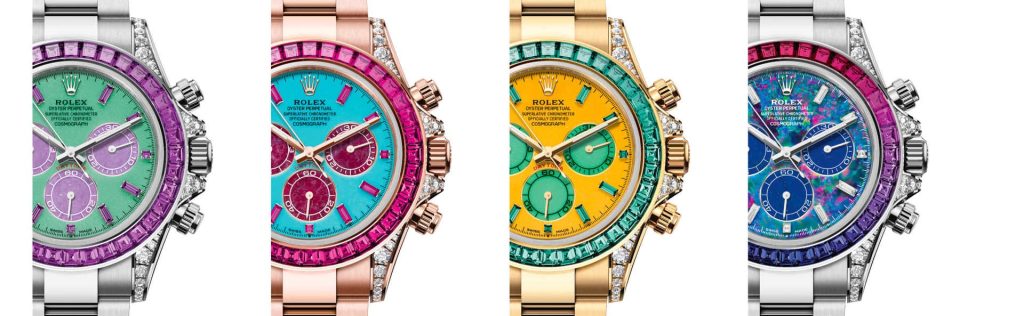
For the Four Seasons project, however, the emphasis moves from the measurement of speed towards the passage of time itself. The four watches are not simply variations in colour. Their materials create a visual sequence: the green and purple mineral tones of Spring, turquoise and pink of Summer, earthy green and yellow-gold hues of Autumn, and the blue-to-fuchsia spectrum of Winter. The seasonal concept gives the four individual lots a shared structure while preserving their distinct identities.
The philanthropic purpose of the auction is equally central. Established in 2003, the Federer Foundation focuses on education and development for children in Southern Africa and Switzerland, supporting opportunities to learn, play and develop. Re, meanwhile, was established by a group of conservation scientists together with Leonardo DiCaprio and works to protect and restore biodiversity through partnerships with Indigenous Peoples, local communities and conservation organisations.
Their inclusion reflects two different but complementary approaches to long-term change: creating opportunities for children and protecting the natural systems on which communities depend. The Four Seasons concept brings those ideas together through an object whose central function is to mark time, while the initiative itself looks towards what can be built and protected over generations.
Rolex’s own history gives that perspective considerable context. The company was founded in London in 1905 by Hans Wilsdorf and Alfred Davis as Wilsdorf & Davis, initially specialising in the distribution of watches. Wilsdorf saw the potential of the wristwatch at a time when pocket watches remained dominant and pursued greater precision, reliability and resistance to water. He coined the Rolex name in 1908, and the company later moved its headquarters to Geneva, where its Swiss watchmaking identity developed. Among the early milestones was the Oyster, introduced in 1926 as the first waterproof wristwatch, followed by the Perpetual self-winding mechanism in 1931.

Today, Rolex remains headquartered in Geneva and operates as an integrated, independent Swiss watch manufacture, producing the majority of its watch components in-house. Its history of technical development sits alongside long-standing commitments to exploration, sport, culture and environmental initiatives, making the Four Seasons project consistent with a broader philosophy of supporting pursuits that extend beyond the watch itself.
For collectors in the UAE, Rolex’s current official retailer network includes locations in both Dubai and Abu Dhabi. Dubai listings include Ahmed Seddiqi at Mall of the Emirates and Four Seasons Resort Dubai, while Abu Dhabi has official Rolex retailers and boutiques including Yas Mall, Marina Mall and The Galleria Al Maryah Island.
The Four Seasons auction gives the Cosmograph Daytona an unusually expansive role. Its chronograph remains rooted in the measurement of elapsed time, yet these four unique examples use colour, mineral and precious stones to suggest the changing character of the year. Offered individually but conceived as one series, they place watchmaking within a wider conversation about education, conservation and the value of thinking beyond the present moment. In that sense, the most meaningful detail may be the one that cannot be set on a dial: what the passage of time is ultimately used to preserve.