
The Breuer Building at Sixty: Sotheby’s Celebrates a Modern Masterpiece
AI-assisted voice playback. Starts only when you choose Play.
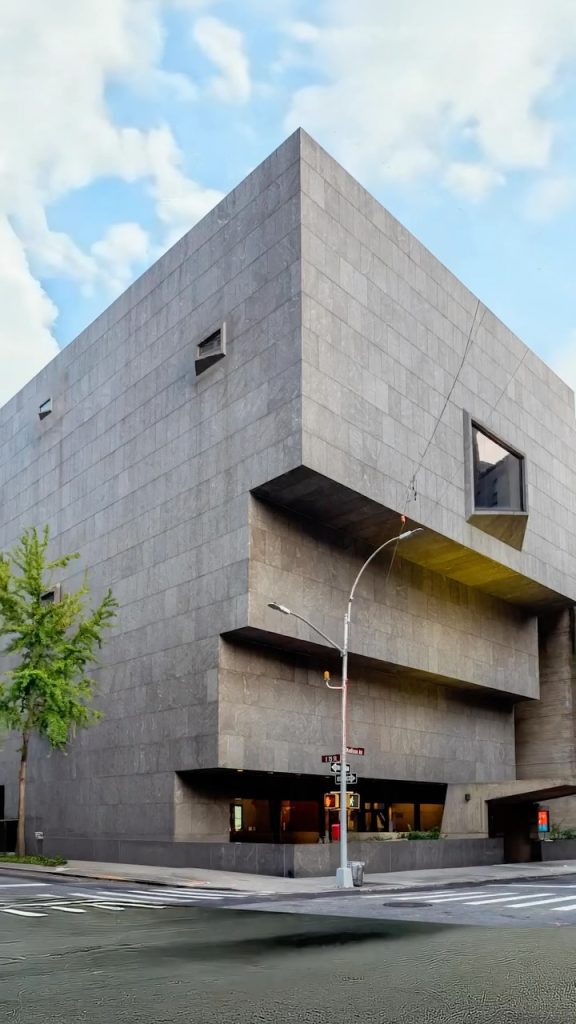
When Marcel Breuer designed the Whitney Museum of American Art's home in 1966, he rejected every convention of institutional architecture. His reverse ziggurat—a bold inversion of the traditional pyramid form—announced itself as an act of creative defiance: a building that questioned what a museum should look like, and by extension, how art itself might be experienced within four walls.
A Building That Thinks Differently
The Breuer Building stands as one of modernism's most intellectually provocative gestures. Rather than aspiring upward in the manner of its contemporaries, the structure descends, creating a silhouette that challenges our understanding of monumentality. Clad in granite and set back from the street with a deliberate reticence, it refuses to shout. Instead, it whispers an invitation to those discerning enough to look closely. The fortress like exterior yields, upon entry, to a series of ingeniously proportioned galleries that shift the viewer's relationship to the art and to architectural space itself.
Six decades after its completion, the Breuer Building remains a touchstone for architects, curators and collectors who believe that the space surrounding art is as crucial as the work itself. Its influence extends far beyond the Whitney's walls, informing debates about institutional design, public experience and the role of architecture in shaping cultural memory.
Dialogue Across Disciplines
Sotheby's New York has chosen this milestone moment to convene leading practitioners and thinkers. Architecture critic Paul Goldberger, whose writings on American design have shaped public discourse for decades, joins Adam D. Weinberg, former director of the Whitney, in examining the building's radical ambitions and enduring legacy. The conversation expands further with Wim Walschap, chief executive and senior partner at Herzog & de Meuron, the Swiss architecture practice whose own work engages with modernism's unfinished questions.
This gathering reflects a broader recognition among collectors and institutions that buildings, like artworks, merit scholarly attention and celebration. The Open House event—scheduled for 3 October at Sotheby's New York—transforms the auction house into a forum for discourse. By hosting such conversations, Sotheby's acknowledges that luxury and connoisseurship extend beyond objects to encompass the spaces in which those objects are held and viewed.
Architecture as Cultural Testament
The sixtieth anniversary of the Breuer Building arrives at a moment when architects worldwide are reconsidering what modernism achieved and what it left unresolved. The structure's uncompromising geometry, its refusal of ornament, its faith in proportion and material truth, all speak to a particular moment in twentieth century thought. Yet the building has only grown more relevant as collectors and curators grapple with questions about access, intimacy and the democratic purpose of cultural institutions.
For those who collect modern and contemporary art, the Breuer Building remains an essential reference point. Its proportions, its handling of light, its dialogue with its urban context all inform how we understand what a space for art should be. That Sotheby's recognises this significance and offers a platform for extended examination underscores the firm's role not merely as a marketplace but as a custodian of cultural understanding.
The Open House invitation is, in essence, an invitation to look again at a building that demands to be understood not as a period piece but as an active participant in contemporary architectural thought. For collectors and those invested in cultural institutions, it is an opportunity to engage with one of modernism's most uncompromising visions.
Key Facts
- Building Completed: 1966
- Architect: Marcel Breuer
- Anniversary: 60 years
- Event Date: 3 October
- Event Location: Sotheby's New York
- Featured Speakers: Paul Goldberger, Adam D. Weinberg, Wim Walschap
The Simply Luxury View
The Breuer Building's sixtieth anniversary reflects a maturation in how the luxury world values architecture. Where once auctions and collecting focused exclusively on portable artworks, the recognition of buildings as cultural artefacts of equal importance marks a significant shift in connoisseurship. Sotheby's positioning itself as host to this conversation underscores that true cultural stewardship extends beyond transactions to intellectual engagement.
For discerning collectors, the event affirms that modernist rigour—particularly Breuer's refusal of decoration in favour of structural honesty—remains a foundational language for understanding twentieth and twenty first century design. The gathering of Goldberger, Weinberg and Walschap suggests that the building's influence is neither historical nor confined, but actively generative of contemporary architectural discourse.
Official brand website: sothebys.com
Imagery is used for editorial purposes. All rights remain with the respective owners, photographers and licensors.
Imagery courtesy of Sotheby's (@sothebys).