
The Apple-1 at Fifty: Computing’s Foundation Stone Comes to Auction
AI-assisted voice playback. Starts only when you choose Play.
Half a century has passed since two visionaries working in a garage set out to place a computer in every home. The Apple-1, designed and hand-built by Steve Wozniak in 1976, was not merely the first pre-assembled personal computer offered for commercial sale; it was a philosophical statement. It announced that computing need not remain the province of institutions and corporations, but could be made intimate, accessible, transformative.
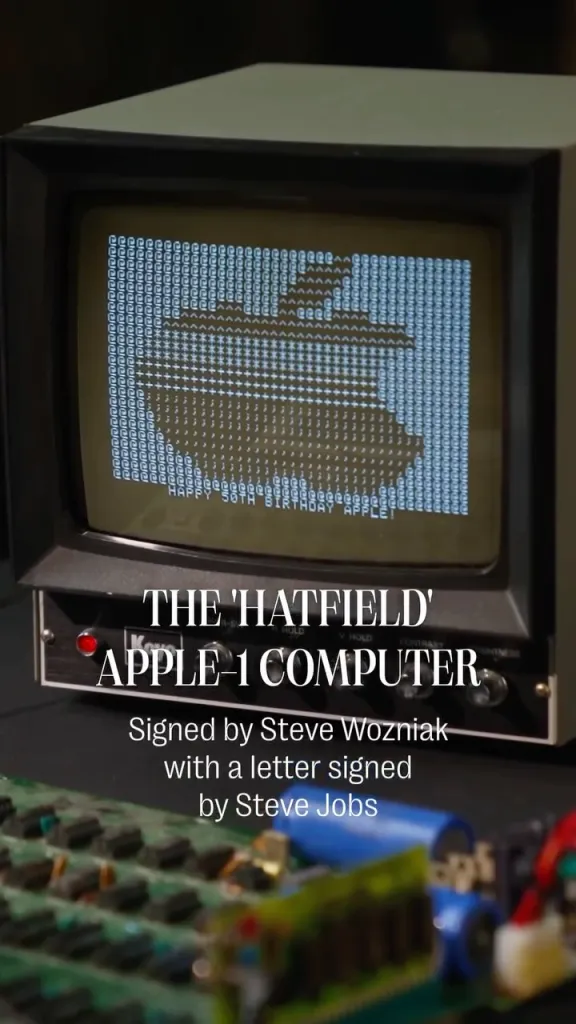
A Machine of Radical Simplicity
The Apple-1 represented a watershed moment in technological history. At a time when microcomputers were often sold as bare circuit boards, requiring assembly and technical knowledge that placed them beyond reach of ordinary users, Wozniak's creation arrived ready to use, requiring only a power supply, a keyboard and a television set. That elegance of approach, that removal of unnecessary friction between intention and capability, would come to define Apple's entire philosophy.
The particular example now on view at Bonhams carries extraordinary provenance. Signed by Wozniak himself, it was owned from the outset by Fred Hatfield, who received an opportunity to upgrade to the Apple II through a 1978 letter from Steve Jobs. Hatfield's decision to decline that offer, to preserve his original machine intact, transformed a commercial transaction into an artefact of genuine historical weight. That restraint, that recognition of what one possessed, speaks across the decades.
Rarity and Survival
Fewer than 75 verified examples of the Apple-1 are known to survive in the world today. Of those, only a small number remain operational. Each represents not merely a product of its era, but a window onto a moment when the personal computer emerged from research laboratories and specialised facilities into human hands. The Apple-1 belongs, in that sense, to the same category of objects as early printing presses, prototype aircraft, or the first locomotives: machines that fundamentally altered what people could do, know and become.
For collectors of technology and design history, the Apple-1 occupies a unique position. It is neither artwork in the traditional sense nor purely functional instrument, but rather a convergence of engineering brilliance, industrial vision and cultural consequence. Its aesthetic is spare, almost austere, yet that restraint itself became influential. In an age of maximalism and ornament, Wozniak and Jobs created something that suggested, quietly, that less could indeed be more.
The Bonhams Milestone
The appearance of the Hatfield Apple-1 at Bonhams New York, on view through 13 October, marks a significant moment for the auction house's History of Science, Technology and Computing department. Such sales reflect a growing recognition among serious collectors and institutions that the objects that shaped the digital revolution merit the same scholarly attention, curatorial care and market consideration as fine art, antiquities or manuscripts.
The accompanying 1978 letter from Jobs adds layers of narrative complexity. It captures a moment when the future was still uncertain, when Jobs and Wozniak were still making conscious decisions about the trajectory of their company. That Hatfield kept the letter, kept the machine, speaks to an intuitive understanding that he was holding something unrepeatable. Fifty years later, history has vindicated that instinct entirely.
The Apple-1 endures as a monument to the power of elegant thinking. It proved that revolutionary change need not announce itself through complexity or grandeur, but can arrive quietly, ready to use, waiting for the imagination of its users to multiply its meaning. That remains its greatest legacy.
Key Facts
- Designed and built: 1976 by Steve Wozniak
- Known surviving examples: Fewer than 75 verified worldwide
- Provenance: Fred Hatfield, original owner
- Accompanied by: 1978 letter from Steve Jobs
- On view: Bonhams New York through 13 October
- Auction: History of Science, Technology & Computing; ends 14 October, online
The Simply Luxury View
For collectors of design and technology history, the Apple-1 occupies a position of unique significance. It is one of fewer than 75 surviving examples globally, and its association with Steve Wozniak's own hand and Steve Jobs's epistolary engagement transforms it from a historical curiosity into a document of the moment computing became personal. This is an object that changed the world, and such objects are rare indeed.
The Wozniak signature and the 1978 Jobs letter confer upon the Hatfield Apple-1 a narrative completeness that few technological artefacts possess. It represents not merely engineering achievement but the precise instant at which two founders recognised the weight of their own creation. For serious collectors, such convergences of hand, intention and consequence are what collecting is ultimately about.
Official brand website: bonhams.com
Imagery is used for editorial purposes. All rights remain with the respective owners, photographers and licensors.
Imagery courtesy of Bonhams (@bonhams1793).