
GREUBEL FORSEY GMT BALANCIER CONVEXE: A MORE COMPACT VISION OF WORLD TIME
Greubel Forsey’s latest GMT Balancier Convexe brings one of the independent watchmaker’s most intricate complications into a more compact titanium case. With a real-time rotating globe, 30-degree inclined balance wheel and newly integrated 72-hour power reserve, the blue edition places mechanical information within a distinctly sculptural architecture.
AI-assisted voice playback. Starts only when you choose Play.
Greubel Forsey’s latest GMT Balancier Convexe brings one of the independent watchmaker’s most intricate complications into a more compact titanium case. With a real-time rotating globe, 30-degree inclined balance wheel and newly integrated 72-hour power reserve, the blue edition places mechanical information within a distinctly sculptural architecture.
Greubel Forsey has never treated the GMT complication as a matter of simply adding another hand to a conventional dial. Since the first Greubel Forsey GMT appeared in 2011, world time at the Swiss Atelier has been expressed through a three-dimensional rotating globe, turning the passage of time across the planet into part of the watch’s visible mechanics. The latest GMT Balancier Convexe continues that approach while making a significant adjustment to proportion: its titanium case has been reduced, its ergonomics refined, and a power reserve display incorporated into the dial.
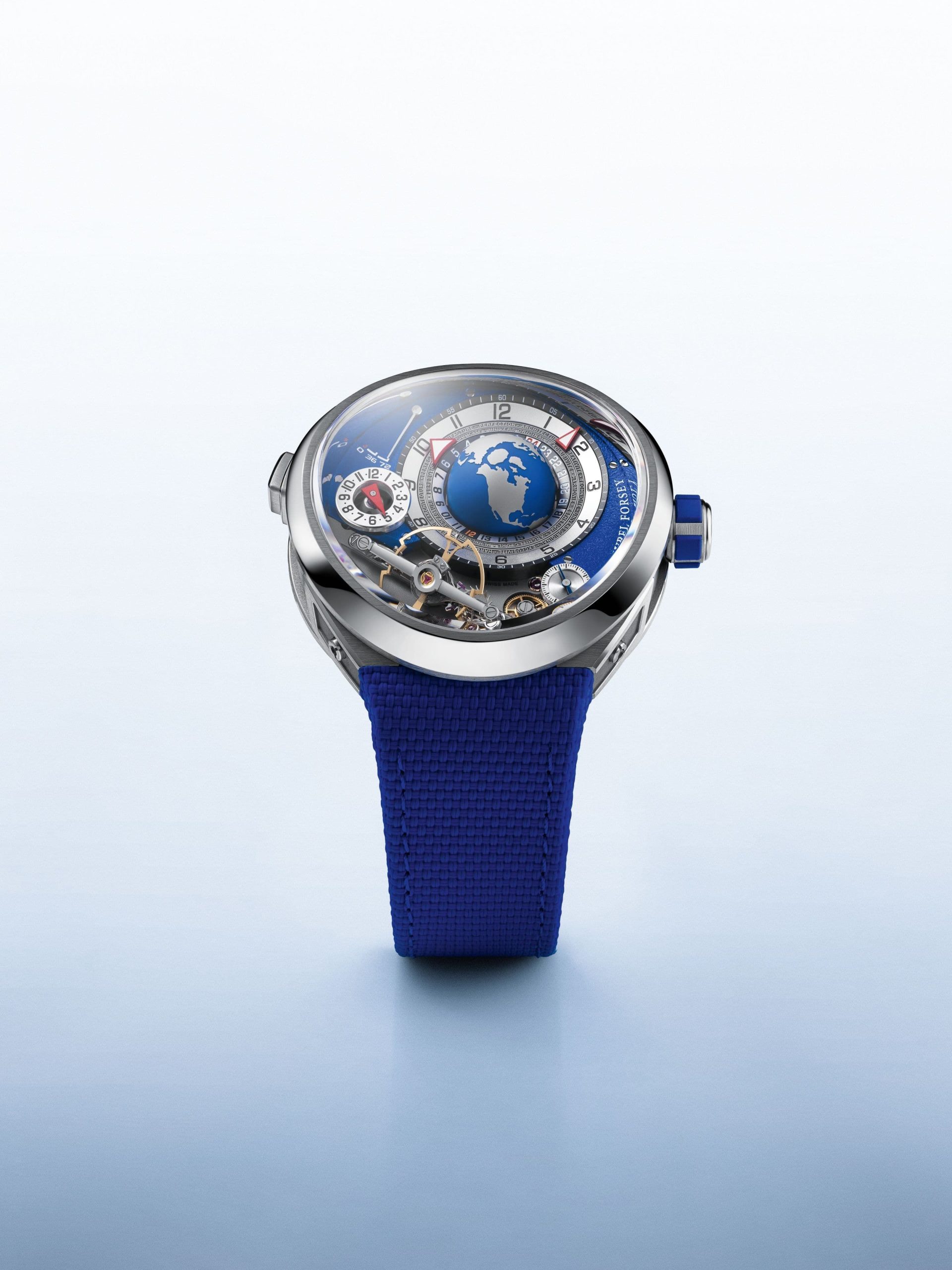
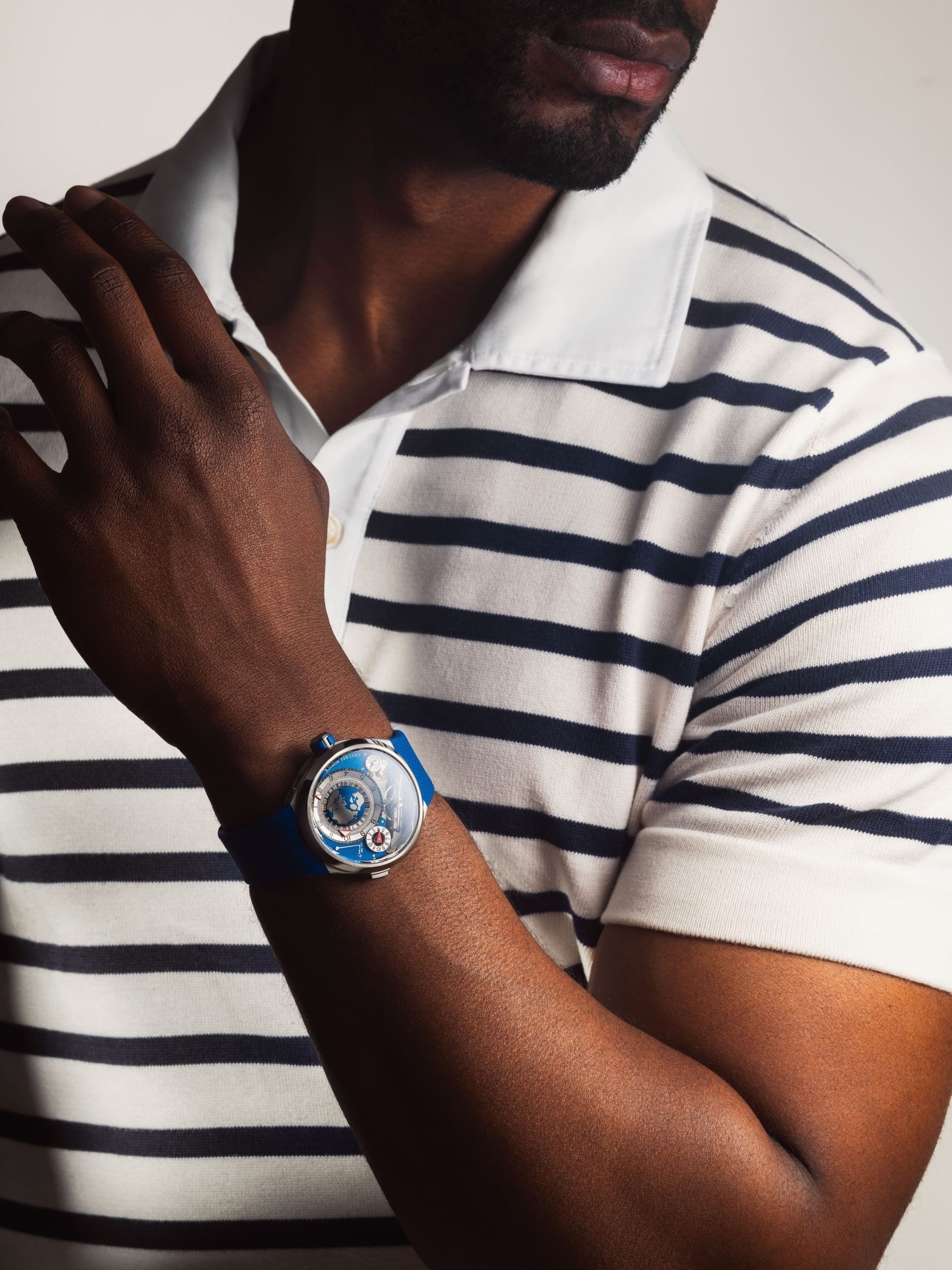
The result is a timepiece that remains unmistakably complex, yet has been reconsidered around the experience of wearing it. The case measures 42.9mm across, while its variable-geometry bezel reaches 44.9mm at its widest point. It remains 15.1mm thick at the case itself, extending to 17.6mm with its domed sapphire crystals. The curved convex architecture is central to its character, following the natural shape of the wrist rather than relying on conventional straight-sided construction.
This represents a reduction from the previous configuration, which measured 43.5mm across the case and 46.5mm at its widest bezel dimension. The smaller footprint was achieved despite the addition of a power reserve indication and 73 extra components within the movement. The case retains its integrated, lugless appearance, while hand-polished and straight-grained surfaces give the titanium architecture contrasting textures. A blue rubber grip surrounds the titanium crown, extending the colour palette beyond the dial itself.
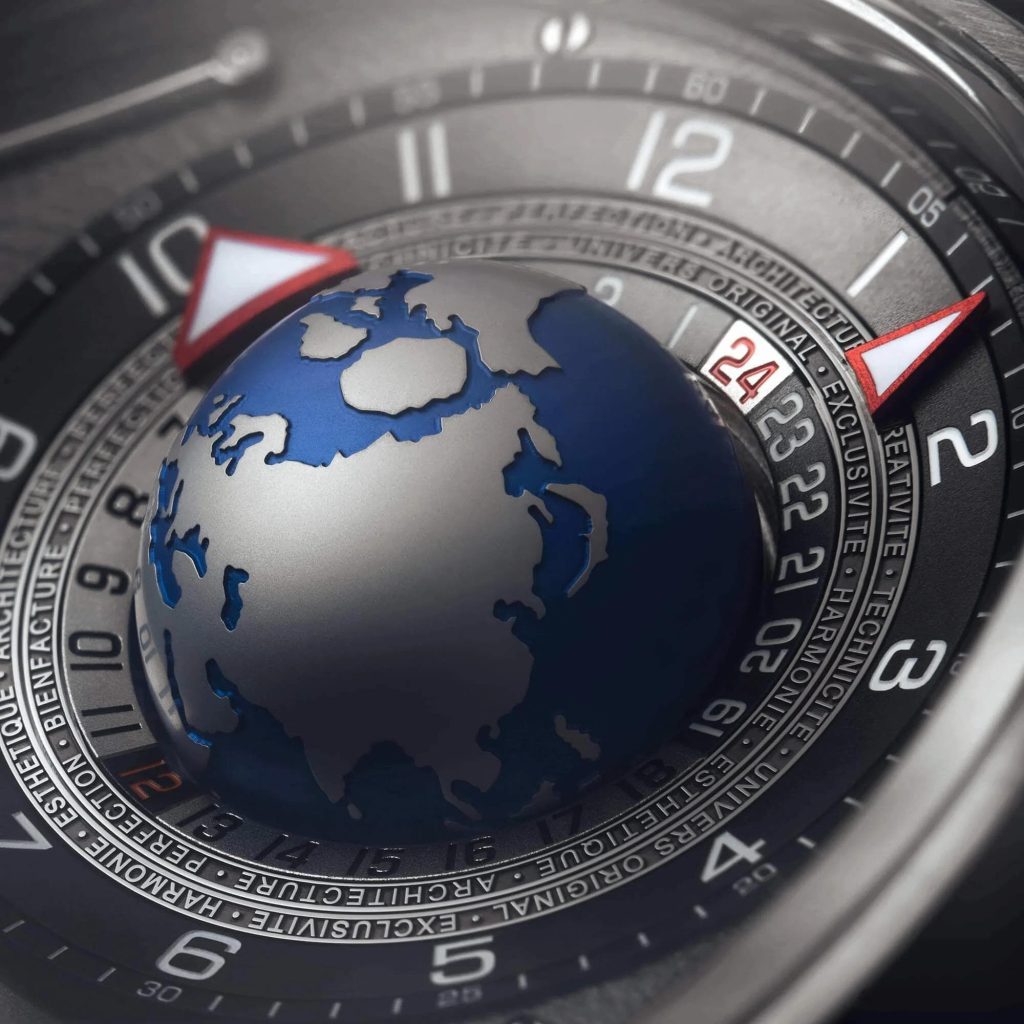
Blue is particularly significant here because it belongs naturally to the watch’s central geographical motif. At the heart of the dial is a titanium terrestrial globe, its continents relief-engraved and its oceans rendered in blue. The globe completes one rotation every 24 hours, allowing universal time and the passage between day and night to be read directly from the miniature representation of Earth. Around it, the dial rises in concentric levels, creating the amphitheatre-like architecture that has become a defining characteristic of the GMT Balancier Convexe.
Local time is displayed around the globe, while a separate gold GMT indication provides the second time zone. The engraved case pusher adjusts this indication in one-hour increments, with each activation simultaneously advancing the globe. Rather than hiding the mechanics of the complication, the construction makes the relationship between the pusher, GMT display, and planetary rotation immediately apparent.
The caseback extends the world-time information. A sapphire disc is engraved with 24 reference cities arranged according to the 24-hour scale, accompanied by indications for summer and winter time. The city ring provides a more conventional reference for universal time, complementing the intuitive reading offered by the rotating globe on the dial.
Beneath this elaborate display, the regulating organ provides another of Greubel Forsey’s characteristic technical signatures. Instead of a tourbillon, the GMT Balancier Convexe uses an in-house variable-inertia balance wheel inclined at 30 degrees. Measuring 12.6mm in diameter, the balance appears suspended beneath a black-polished steel bridge across the lower portion of the dial. It operates at 21,600 vibrations per hour, or 3Hz, and is designed around Greubel Forsey’s long-standing interest in the relationship between geometry and chronometric performance.
The manual-winding movement contains 496 components and 72 jewels. Its architecture incorporates two series-coupled fast-rotating barrels, providing a 72-hour power reserve. The new reserve indication is positioned in the upper-left portion of the dial, with an elongated hand tracing a 72-hour scale. Its placement is carefully integrated into the existing composition, allowing another practical indication without disrupting the visual hierarchy established by the globe and inclined balance.
The movement itself measures 37.8mm in diameter and 13.8mm thick. Its visible components are treated as part of the overall architecture rather than concealed beneath a conventional dial, reinforcing Greubel Forsey’s preference for displaying the mechanical structure of its watches. The brand’s official collection describes the GMT Balancier Convexe as its complete expression of the GMT complication, bringing together second-time-zone information, universal time, day-and-night indication and world time across 24 zones.
The blue edition is paired with a hand-sewn textured rubber strap and titanium folding clasp, with a titanium bracelet available on request. Its colour treatment extends from the globe and bridges to the strap and crown, giving the complex architecture a more coherent visual field. The watch is water-resistant to 50 metres, a specification that reflects its technical construction while remaining secondary to its horological purpose.
Greubel Forsey’s history helps explain why such an approach to mechanical watchmaking feels so distinctive. Robert Greubel and Stephen Forsey began combining their talents in 1999, initially concentrating their research on the escapement. The Greubel Forsey Atelier was established in 2004, when the Double Tourbillon 30° became the first of their major inventions. The manufacture is based in La Chaux-de-Fonds, Switzerland, within the historic watchmaking landscape of the Jura. Its Experimental Watch Technology programme, established in 2005, has provided a platform for long-term research into mechanical innovation, while the Atelier has continued to place hand finishing and technical invention at the centre of its work. In 2022, Greubel Forsey became completely independent following the acquisition of Richemont’s shares in the company.
The GMT itself arrived in 2011, marking the Atelier’s first in-house complication beyond its earlier focus on the escapement and tourbillon. Its rotating globe introduced a different way of representing world time, turning geography into an active component of the mechanism. The current Balancier Convexe retains that principle while replacing the tourbillon with the inclined balance system that defines the Balancier family.
Production of the new blue GMT Balancier Convexe is limited to 22 timepieces. Specialist watch publications have reported a price of CHF 380,000, excluding applicable taxes. The official Greubel Forsey site confirms the 22-piece limitation and directs enquiries through its concierge and retail network.
Greubel Forsey’s current official boutique directory lists dedicated boutiques in New York and Tokyo, alongside selected retail partners across its international network. The official directory currently does not list a dedicated Greubel Forsey boutique in the UAE, so no Dubai or Abu Dhabi location is attributed here. For availability and authorised points of sale, the brand’s official boutique and retail-partner directory remains the appropriate reference.
The GMT Balancier Convexe ultimately demonstrates how complexity can be reorganised rather than simply increased. A smaller case accommodates a more capable movement; a practical power reserve becomes part of the composition; and a familiar GMT function is expressed through an Earth that physically turns beneath the sapphire crystal. In the blue edition, technical information and visual language converge around a single idea: world time is not merely indicated, but given a mechanical landscape of its own.