
MONCLER BRINGS THE MOUNTAIN TO FIFTH AVENUE IN ITS LARGEST FLAGSHIP YET
Moncler’s 2,200-square-metre Fifth Avenue flagship translates alpine materiality into a two-level New York brand world, with an entire floor dedicated to Grenoble.
AI-assisted voice playback. Starts only when you choose Play.
A flagship used to mean a larger shop in a better postcode. The most ambitious luxury brands now ask more of the format: it must explain the company, entertain visitors, host culture, and still work as a serious retail environment. Moncler’s new Fifth Avenue address embraces that expanded brief at full scale. At 2,200 square metres across two levels, it is the largest flagship in the brand’s global network.
MOUNTAIN DNA, MANHATTAN SCALE
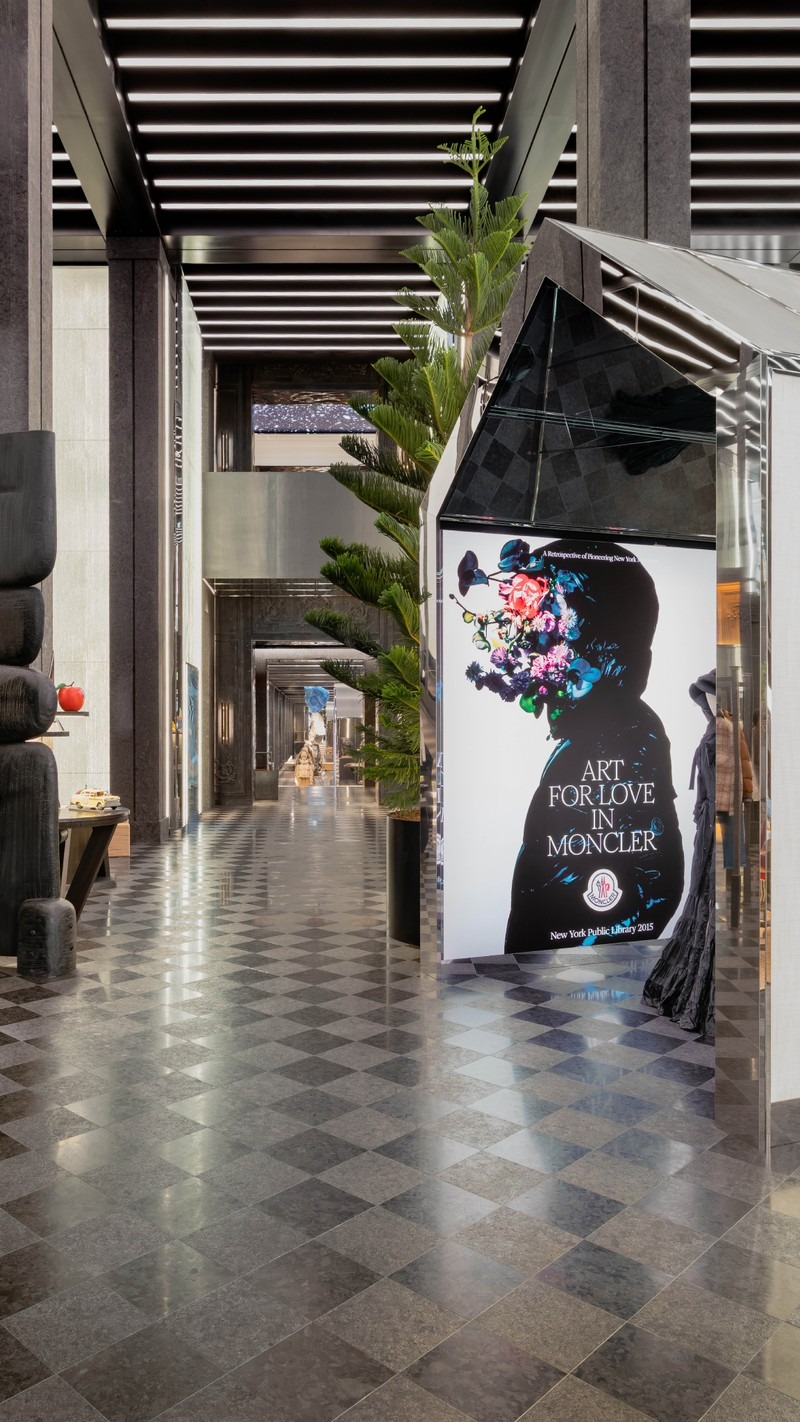
The location does much of the symbolic work. The store sits at 767 Fifth Avenue at the base of the General Motors Building, a short walk from Central Park and in one of the most intensely branded retail corridors in the world. Rather than suppress its alpine identity to fit Manhattan, Moncler has brought mountain materiality into the city.
The façade combines glass with Saint Williams granite and integrated LED elements. Inside, polished and raw surfaces appear together, including the checkerboard floor treatment that contrasts refinement with something deliberately more elemental. The result is not a chalet transplanted into New York; it is a metropolitan interpretation of the textures and physicality that sit behind the Moncler name.
A STORE THAT FUNCTIONS LIKE A BRAND MAP
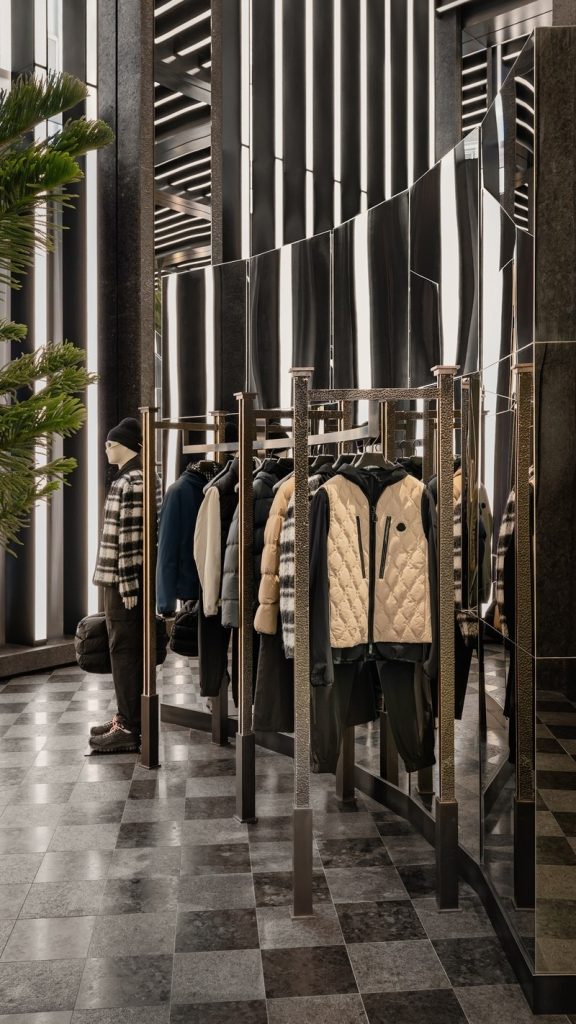
The two levels also explain how broad Moncler has become. The ground floor brings together the main men’s, women’s and children’s collections, footwear and the collaborative Moncler Genius platform. Upstairs, the entire level is dedicated to Moncler Grenoble, turning the technical mountain line into a complete year-round proposition rather than a seasonal corner.
That division matters. Grenoble has increasingly become the part of Moncler where performance credentials and luxury positioning are expected to coexist without apology. The Fifth Avenue floor carries lightweight systems alongside technical ski pieces, with equipment collaborations including Stöckli skis, POC helmets and snowboards associated with Shaun White. In a traditional fashion boutique, those objects might read as accessories. Here they provide context: the clothes are linked back to an environment and activity.
Moncler also describes the flagship as a place for community, discovery and cultural exchange, with exclusive products, services and activations built into the programme. That language is familiar across luxury retail, but the scale gives the company room to make it tangible through art, architecture and changing experiences rather than simply through visual merchandising.
WHY FLAGSHIPS STILL MATTER
The timing is notable because luxury retail has spent years discussing digital convenience. Online commerce made product access easier, yet it also made physical stores more important as places where a brand can control atmosphere, proportion, and pace. The best flagships now justify the journey by offering something a product grid cannot reproduce.
Moncler’s advantage is that it has a clear tension to work with: mountain and city, performance and fashion, expedition logic and social spectacle. Fifth Avenue compresses those opposites into a single address. The stone and checkerboard surfaces provide the material story, while the two-floor product architecture shows how the house has expanded beyond the down jacket without abandoning it as a cultural reference point.
For New York, it is another enormous luxury statement on Fifth Avenue. For Moncler, it is more specific: proof that its alpine vocabulary can be scaled up to one of the world’s most urban stages without becoming costume.