
IWC’s Titanium Perpetual Calendar: Engineering Precision at its Lightest
AI-assisted voice playback. Starts only when you choose Play.
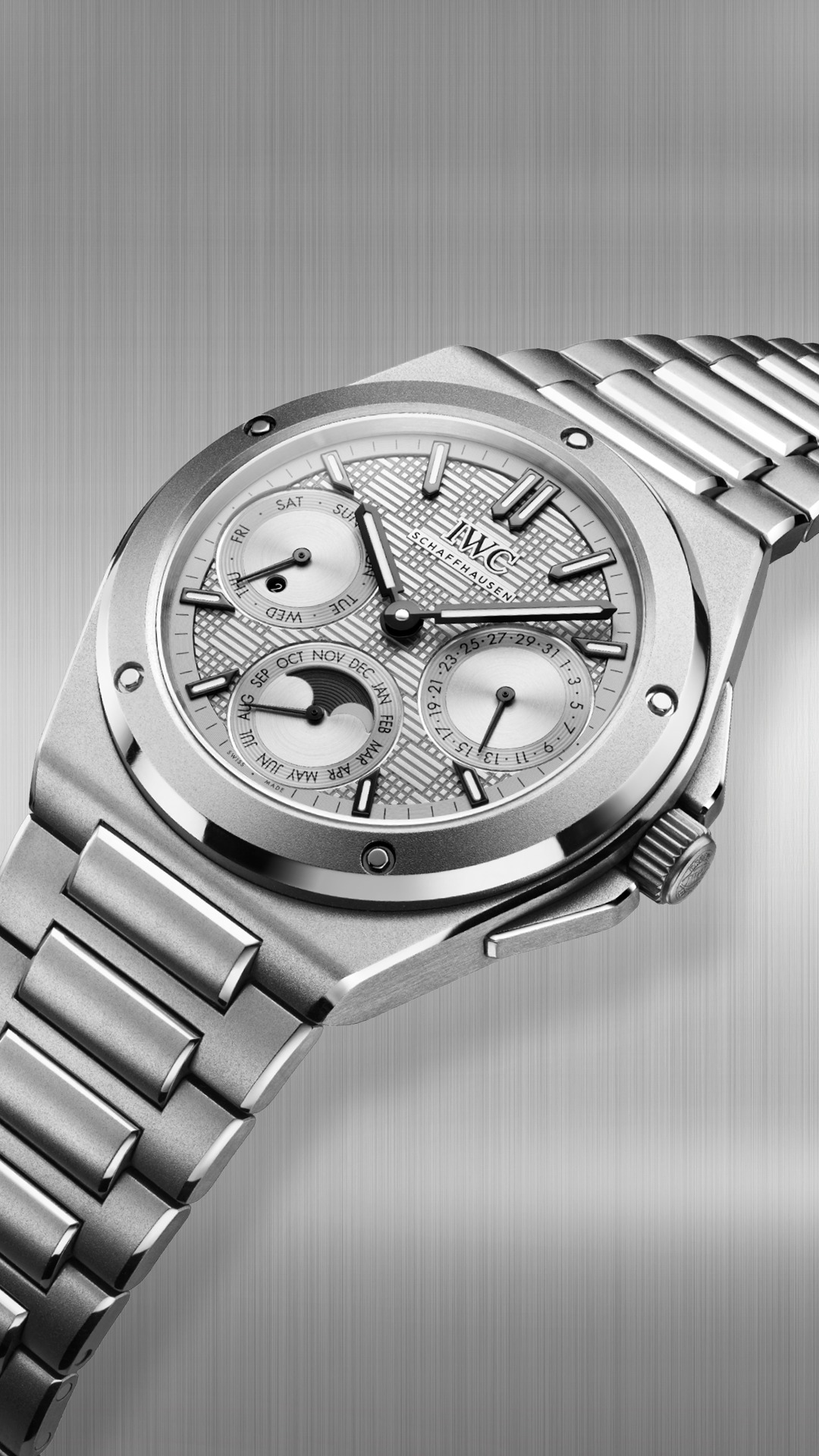
Horological achievement often resides in the paradox of adding complexity whilst reducing weight. This principle guides IWC Schaffhausen's latest interpretation of its perpetual calendar complication—a timepiece that demonstrates how materials innovation and mechanical refinement can converge to redefine a collector's expectations of what a perpetual calendar watch should feel like on the wrist.
The new reference IW344904 represents a significant milestone for the manufacture: it is the lightest perpetual calendar watch IWC has ever produced. This distinction owes entirely to the deployment of grade 5 titanium, a material increasingly favoured in horological circles for its exceptional strength-to-weight ratio, corrosion resistance, and aesthetic neutrality.
The Legacy of Kurt Klaus
The perpetual calendar mechanism at the heart of this watch traces its lineage to Kurt Klaus, the legendary watchmaker whose design has become synonymous with IWC's most sophisticated annual complications. Klaus's engineering solution elegantly addresses one of mechanical watchmaking's most demanding challenges: a calendar that requires no manual adjustment until the year 2100, when the Gregorian calendar's four-century correction cycle necessitates recalibration.
What distinguishes Klaus's approach from other perpetual calendars is its mechanical intelligence—a series of carefully orchestrated cams and levers that automatically account for the irregularity of months, compensating for February's variability with the sort of prescient logic that rewards contemplation. This mechanism has remained largely unchanged across decades, testament to its foundational soundness and the refusal to tinker with excellence.
Titanium: Material Strategy
Grade 5 titanium—an alloy of titanium, aluminium and vanadium—occupies a particular niche in watchmaking. Its density is approximately 43 per cent that of stainless steel, yet it exhibits superior hardness and resistance to corrosion. For a perpetual calendar watch, which demands flawless longevity and the confidence that its mechanism will perform reliably across generations, titanium's durability profile is persuasive.
The choice of material extends beyond mere technical specification. Titanium possesses an aesthetic character distinct from precious metals or steel—cooler in tone, subtly luminous, with a surface that ages with quiet dignity. For the discerning collector, this material choice signals a preference for engineering substance over ostentation, a philosophy entirely consonant with IWC's design philosophy and the sensibility of the Ingenieur collection to which this watch belongs.
Integrated Architecture
The integration of the bracelet with the case represents a further refinement in the watch's overall realisation. Rather than treating the bracelet as a detachable component, IWC has engineered it as an integral part of the case structure. This approach yields several advantages: enhanced structural rigidity, reduced overall weight, and visual coherence that elevates the watch from a collection of parts into a unified object.
An integrated titanium bracelet demands precision manufacturing and an intimate understanding of how metal responds to stress and movement. The links must articulate smoothly whilst maintaining dimensional consistency; the attachment points must distribute load evenly to prevent premature wear. These engineering considerations inform every aspect of the design, making the bracelet not merely functional but integral to the watch's performance and longevity.
The Crown-Controlled Calendar
The perpetual calendar's adjustment mechanism—accessed via the crown—distinguishes this complication from simpler annual calendars. Rather than requiring a watchmaker's intervention to correct the display, the crown permits the wearer to advance or retard the calendar functions with precision. This accessibility democratises the relationship between owner and complication, transforming the perpetual calendar from a remote marvel into a functioning tool within the wearer's command.
The engineering of this interface demands exceptional attention to detail. The crown must transmit rotational input cleanly to the calendar mechanism without introducing backlash or inconsistency. A poorly executed crown-to-complication connection can undermine the entire system; precision here is non-negotiable.
The Collector's Calculation
For the collector considering a perpetual calendar watch, weight is rarely the primary consideration. Indeed, the substantial presence of a precious-metal perpetual calendar is often understood as an expression of its inherent value and mechanical complexity. Yet IWC's titanium strategy invites recalibration of these assumptions.
A lighter perpetual calendar watch alters the wearing experience fundamentally. Wrist fatigue diminishes over extended periods of wear; the watch becomes less a testament to endurance and more an expression of refined everyday practicality. For the collector who views horological complications as instruments rather than monuments, this distinction carries genuine significance.
The reference IW344904 exemplifies a particular sophistication in contemporary watchmaking: the willingness to question received wisdom about how a complication should be executed, and the confidence to pursue an unconventional material strategy when it serves the watch's ultimate purpose. In titanium, IWC has not compromised the perpetual calendar; it has liberated it.
Imagery is used for editorial purposes. All rights remain with the respective owners, photographers and licensors.
Imagery courtesy of IWC Schaffhausen (@iwcwatches).